-
Your next favorite book
is waiting.
Summary | Excerpt | Reviews | Beyond the book | Read-Alikes | Genres & Themes | Author Bio
A Natural and Cultural History
by Cynthia Barnett Book Reviewed by:
Rain is elemental, mysterious, precious, destructive. It is the subject of countless poems and paintings; the top of the weather report; the source of the world's water. This is the first book to tell the story of rain.
Rain is elemental, mysterious, precious, destructive.
It is the subject of countless poems and paintings; the top of the weather report; the source of the world's water. Yet this is the first book to tell the story of rain.
Cynthia Barnett's Rain begins four billion years ago with the torrents that filled the oceans, and builds to the storms of climate change. It weaves together science - the true shape of a raindrop, the mysteries of frog and fish rains - with the human story of our ambition to control rain, from ancient rain dances to the 2,203 miles of levees that attempt to straitjacket the Mississippi River. It offers a glimpse of our "founding forecaster," Thomas Jefferson, who measured every drizzle long before modern meteorology. Two centuries later, rainy skies would help inspire Morrissey's mopes and Kurt Cobain's grunge. Rain is also a travelogue, taking readers to Scotland to tell the surprising story of the mackintosh raincoat, and to India, where villagers extract the scent of rain from the monsoon-drenched earth and turn it into perfume.
Now, after thousands of years spent praying for rain or worshiping it; burning witches at the stake to stop rain or sacrificing small children to bring it; mocking rain with irrigated agriculture and cities built in floodplains; even trying to blast rain out of the sky with mortars meant for war, humanity has finally managed to change the rain. Only not in ways we intended. As climate change upends rainfall patterns and unleashes increasingly severe storms and drought, Barnett shows rain to be a unifying force in a fractured world. Too much and not nearly enough, rain is a conversation we share, and this is a book for everyone who has ever experienced it.
Excerpt
Rain
From those cataclysmic torrents 4 billion years ago to the hydrologic cycle that slakes aquifers, soil, and rivers day after day, rain, as the source of Earth's water, became the wellspring of life. "Sunshine abounds everywhere," the American nature writer John Burroughs wrote in a paean that soaked nine pages of Scribner's magazine in 1878, "but only where the rain or dew follows is there life."
Life, and something more. Humans have a natural affinity for rain, grounded in its necessity for civilization and agriculture. Thomas Jefferson constantly watched the sky from his Monticello home in Virginia, where cerulean thunderclouds build along the Blue Ridge Mountains as if matched by Picasso. Jefferson fretted over cloudless days the way that all farmers do. He found relief when storms returned, carrying moisture from the yet-mysterious West. His letters often closed with a word on the rain—or the lack. "Not enough rain to lay the dust," he would lament. ...
Barnett delivers an endlessly whimsical and engaging narrative tour of rain through life’s many lenses. It is a testament to her writing ability that the reader will be left wanting more — a consistently drenching information soak instead of mere drizzle in places...continued
Full Review
 (700 words)
(Reviewed by Poornima Apte).
 Bill BcKibben, author of Eaarth
Rain - the thing the weatherman frowns about - is one of the planet's great pulses, as this marvelous book makes clear. Read it now, recalling the rainstorms we grew up with, and anticipating the harsh new rainfall that's coming our way on a warming globe. David George Haskell, author of The Forest Unseen; professor of biology, University of the South
Brilliant, insightful, and beautifully written. Raindrops are prisms through which we see the surprising and profound connections among water, human history, and our uncertain future. Douglas Brinkley, author of The Wilderness Warrior; professor of history, Rice University
In Rain, Cynthia Barnett has given us a landmark work of environmental history. She brilliantly illuminates the essential weather conditions that allow our blue-marble earth to exist. From now on I'll think about raindrops differently. Rain is a triumph. Elizabeth Kolbert, author of The Sixth Extinction
Rain is a lovely, lyrical, deeply informative book. It will change the way you look at gray skies, and sunny ones, too. Richard Louv, author of Last Child in the Woods
Some of the most lyrical and surprising nature writing that I have ever read. This book is filled with wonder, as mysterious as the shape of a falling raindrop, which is not the drop we imagine, but a concave little parachute drifting to the earth below. After reading this, you will never look up the same way again. William Souder, author of On a Farther Shore: The Life and Legacy of Rachel Carson
Rain is one of the most elegant and absorbing books ever written about the natural world. Writing with grace and imagination, Cynthia Barnett takes you on a journey into the heart of the most elemental force in our lives. An important, revelatory, and thoroughly wondrous book.
Bill BcKibben, author of Eaarth
Rain - the thing the weatherman frowns about - is one of the planet's great pulses, as this marvelous book makes clear. Read it now, recalling the rainstorms we grew up with, and anticipating the harsh new rainfall that's coming our way on a warming globe. David George Haskell, author of The Forest Unseen; professor of biology, University of the South
Brilliant, insightful, and beautifully written. Raindrops are prisms through which we see the surprising and profound connections among water, human history, and our uncertain future. Douglas Brinkley, author of The Wilderness Warrior; professor of history, Rice University
In Rain, Cynthia Barnett has given us a landmark work of environmental history. She brilliantly illuminates the essential weather conditions that allow our blue-marble earth to exist. From now on I'll think about raindrops differently. Rain is a triumph. Elizabeth Kolbert, author of The Sixth Extinction
Rain is a lovely, lyrical, deeply informative book. It will change the way you look at gray skies, and sunny ones, too. Richard Louv, author of Last Child in the Woods
Some of the most lyrical and surprising nature writing that I have ever read. This book is filled with wonder, as mysterious as the shape of a falling raindrop, which is not the drop we imagine, but a concave little parachute drifting to the earth below. After reading this, you will never look up the same way again. William Souder, author of On a Farther Shore: The Life and Legacy of Rachel Carson
Rain is one of the most elegant and absorbing books ever written about the natural world. Writing with grace and imagination, Cynthia Barnett takes you on a journey into the heart of the most elemental force in our lives. An important, revelatory, and thoroughly wondrous book.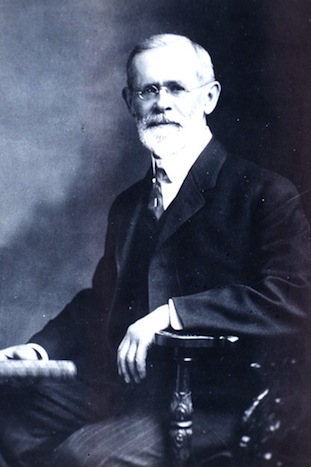 One of the many people profiled briefly in Rain: A Natural And Cultural History, is Cleveland Abbe, a pioneer in American meteorology. Born in New York City in 1838, the eldest of seven siblings, Abbe would go on to earn professional degrees in astronomy. But as he advanced his studies, he increasingly came to realize the intersection between the study of celestial objects and the weather: "Astronomers who would improve their meridional measurements must investigate their local atmospheric conditions more thoroughly, and to this end must have numerous surrounding meteorological observations." It was also time, he said, for science to play a role in forecasting, something that was until then under the purview of "local lore and weather ...
If you liked Rain, try these:
by Simon Garfield
Published 2018
As managing time becomes the greatest challenge we face in our lives, this multi-layered history helps us tackle it in a sparkling new light.
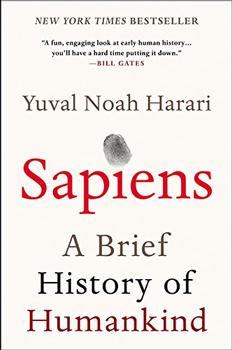
by Yuval Noah Harari
Published 2018
A groundbreaking narrative of humanity's creation and evolution that explores the ways in which biology and history have defined us and enhanced our understanding of what it means to be "human."
by Nicholas A. Basbanes
Published 2014
A consideration of all things paper: Entertaining, illuminating, irresistible, a book that masterfully guides us through paper's inseparability from human culture.
 (1).gif)
The low brow and the high brow
Click Here to find out who said this, as well as discovering other famous literary quotes!

Can you name the title?
Test your book knowledge with our daily trivia challenge!