
-
Your next favorite book
is waiting.
Summary | Excerpt | Reviews | Beyond the book | Read-Alikes | Genres & Themes | Author Bio

 Book Reviewed by:
Jasmine Aimaq's stunning debut explores Afghanistan on the eve of a violent revolution and the far-reaching consequences of a young Kochi girl's tragic death.
Afghanistan, 1970s. Born to an American mother and a late Afghan war hero, Daniel Sajadi has spent his life navigating a complex identity. After years in Los Angeles, he is returning home to Kabul at the helm of a US foreign aid agency dedicated to eradicating the poppy fields that feed the world's opiate addiction.
But on the drive out of Kabul for an anniversary trip with his wife, Daniel accidentally hits and kills a young Kochi girl named Telaya. He is let off with a nominal fine, in part because nomad tribes are ignored in the eyes of the law, but also because a mysterious witness named Taj Maleki intercedes on his behalf. Wracked with guilt and visions of Telaya, Daniel begins to unravel, running from his crumbling marriage and escalating threats from Taj, who turns out to be a powerful opium khan willing to go to extremes to save his poppies.
This groundbreaking literary thriller reveals the invisible lines between criminal enterprises and political regimes—and one man's search for meaning at the heart of a violent revolution.
PROLOGUE
The girl lies crumpled and still in the road, like a thing thrown away. It cannot be that I am the one who has done this to her. Just a moment ago, she ran across the road, lively, smiling, and quick. Beside me, my wife is screaming. I cannot move, but I do, my hands heavy as I take them from the steering wheel and step into the desolate road. My legs protest, but I walk. I fall to my knees and take the girl's hand. A small whimper. She is alive.
"Please, don't move. You're going to be all right." My voice breaks, sounding alien, each word between a quiver and a sob. The girl's limbs are tangled, her head tilted at an impossible angle. A bruise blackens her neck. Her red dress grows darker, blood blooming through the cotton, which rises in the breeze and settles back onto her body a shroud.
The endless desert, the Afghan sun, the silent sky. They watch. The road is the only thing in motion. The asphalt ripples in the heat, as if ready to open up and engulf us, making the ...
Aimaq fictionalizes America's entanglement in Afghanistan with reference or allusion to historical events and players. She does so in a manner that depicts the stark inequality and poverty in the country as well as the politically expedient nature of US foreign policy. Throughout most of the book, Aimaq employs a third-person point of view that provides insight into the duality of Daniel's American and Afghani perspectives. This approach is also effective in relating the unspoken sentiments and past experiences that give depth to the characters and infuse their relationships with dramatic tension...continued
Full Review
 (756 words)
(Reviewed by Daniela Schofield).
 Cara Black, New York Times bestselling author of the Aimée Leduc series and Three Hours in Paris
The Opium Prince is an evocative, overdue tale of Afghanistan, written with searing insight by Jasmine Aimaq. Against the backdrop of 1970s Kabul, Aimaq sets an edgy cat-and-mouse game between a half-Afghan US government official and an opium khan, threaded together by the hard beauty of the country's land and people. I couldn't put it down. Chaya Deitsch, author of Here and There: Leaving Hasidism and Keeping My Family
I love this book. Daniel Sajadi is a complicated protagonist: an idealist, a loving husband, and the burdened son of a hero, so driven by his goals that he's blind to the consequences of his actions, yet we never stop rooting for him. Jasmine Aimaq's writing is gorgeous, creating a fully immersive universe—the sights, sounds and smells of city versus desert; the fields of poppies; and the Russian tanks and cigarette smoke of an Afghanistan unlike the one most Americans know. A cinematic yet introspective page-turner. Graham Fuller, former CIA Station Chief in Kabul and author of A World Without Islam
A gripping story that delves into the 'real Afghanistan' that lies behind the headlines. Jasmine Aimaq brings deep personal and family knowledge of Afghanistan to bear on the full panoply of actors in the tragedy of Afghanistan: US shortsightedness, determined Islamists, family bonds, and Afghan moderates trying to find an in-between. Deeply informed, beautifully written, vivid characters, with a real feel for this complex culture and geopolitical agony from competing perspectives. A stunning debut literary novel.
Cara Black, New York Times bestselling author of the Aimée Leduc series and Three Hours in Paris
The Opium Prince is an evocative, overdue tale of Afghanistan, written with searing insight by Jasmine Aimaq. Against the backdrop of 1970s Kabul, Aimaq sets an edgy cat-and-mouse game between a half-Afghan US government official and an opium khan, threaded together by the hard beauty of the country's land and people. I couldn't put it down. Chaya Deitsch, author of Here and There: Leaving Hasidism and Keeping My Family
I love this book. Daniel Sajadi is a complicated protagonist: an idealist, a loving husband, and the burdened son of a hero, so driven by his goals that he's blind to the consequences of his actions, yet we never stop rooting for him. Jasmine Aimaq's writing is gorgeous, creating a fully immersive universe—the sights, sounds and smells of city versus desert; the fields of poppies; and the Russian tanks and cigarette smoke of an Afghanistan unlike the one most Americans know. A cinematic yet introspective page-turner. Graham Fuller, former CIA Station Chief in Kabul and author of A World Without Islam
A gripping story that delves into the 'real Afghanistan' that lies behind the headlines. Jasmine Aimaq brings deep personal and family knowledge of Afghanistan to bear on the full panoply of actors in the tragedy of Afghanistan: US shortsightedness, determined Islamists, family bonds, and Afghan moderates trying to find an in-between. Deeply informed, beautifully written, vivid characters, with a real feel for this complex culture and geopolitical agony from competing perspectives. A stunning debut literary novel.The events of Jasmine Aimaq's debut novel, The Opium Prince, play out in the lead-up to the 1978 Saur Revolution, in which the Afghan president Mohammed Daud Khan was assassinated and overthrown by the Soviet-backed Marxist People's Democratic Party of Afghanistan (the PDPA). The president had himself come to power in 1973 by overthrowing the monarch Mohammed Zahir Shah with the backing of the PDPA but had eventually grown wary of the party's Soviet influence.
Between these two revolutionary events, Aimaq's protagonist, Daniel Sajadi, is in Afghanistan as the director of an American agency that aims to fight the cultivation of opium by encouraging and aiding the cultivation of food crops. While the agency, USADE, is fictional, its ...
If you liked The Opium Prince, try these:
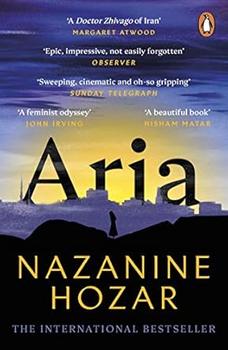
by Nazanine Hozar
Published 2021
An extraordinary, cinematic saga of rags-to-riches-to-revolution--called a "Doctor Zhivago of Iran" by Margaret Atwood--that follows an orphan girl coming of age at a time of dramatic upheaval.
by Kim Barker
Published 2012
A true-life Catch-22 set in the deeply dysfunctional countries of Afghanistan and Pakistan, by one of the region's longest-serving correspondents.
by Dan Fesperman
Published 2005
A burned-out war correspondent hoping for a last hurrah in Afghanistan arrives on the Afghan border just as American bombs begin falling on the ruling Taliban in this fast-paced, timely, and galvanizing novel.

 (1).gif)
Any activity becomes creative when the doer cares about doing it right, or better.
Click Here to find out who said this, as well as discovering other famous literary quotes!

Can you name the title?
Test your book knowledge with our daily trivia challenge!