
-
Your next favorite book
is waiting.
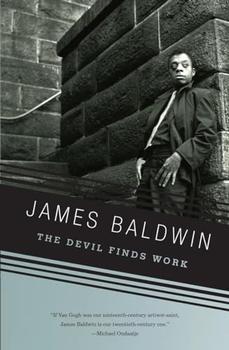
An Essay
by James Baldwin
From "the best essayist in this country" (The New York Times Book Review) comes an incisive book-length essay about racism in American movies that challenges the underlying assumptions in many of the films that have shaped our consciousness.
Baldwin's personal reflections on movies gathered here in a book-length essay are also an appraisal of American racial politics. Offering a look at racism in American movies and a vision of America's self-delusions and deceptions, Baldwin considers such films as In the Heat of the Night, Guess Who's Coming to Dinner, and The Exorcist.
Here are our loves and hates, biases and cruelties, fears and ignorance reflected by the films that have entertained and shaped us. And here too is the stunning prose of a writer whose passion never diminished his struggle for equality, justice, and social change.
Did you read any books in 2025 that are widely considered classics? If so, which ones and why?
...ind of consider classics, and I guess that's because they're still widely read and thought of as "good books" many decades after they were published: The Devil Finds Work by James Baldwin Bloodchild, The Parable of the Sower , and The Parable of the Talents , by Octavia Butler Alias Grace , by Margaret Atwood Cider House Rules , by Joh...
-kim.kovacs
Overall, what did you think of The Devil Finds Work?
That James Baldwin was insightful and thoughtful. His words were powerful and full of empathy.
-Heather_J
Baldwin died in 1987. Which movies that premiered after his death, featuring Black actors in major roles, would you have liked his opinion on?
I'd like to hear his thoughts on Get Out.
-Heather_J
Which of the films that James Baldwin mentions are you familiar with? How has your opinion of these movies changed since reading The Devil Finds Work?
I suppose am aging myself to say that I saw In the Heat of the Night, Guess Who's Coming to Dinner and The Defiant One in the theatres as I was growing up. I didn't see as a young kid, living in a very white community, black people until my freshman year of college and then the person I met was a...
-Kassapa
Is it possible for a white screenwriter or director to authentically capture a Black person’s experiences? Is it possible for a white audience to determine when a film is a realistic portrayal of a Black person’s life or will bias always stand in the way?
I understand the issue, and I say "no" to both questions. That said, movies are not truth. I can't think of a single film that I didn't think at the beginning how the premise was flawed. Movies are art but they are also commercial operations. Films have made a great deal of progress in representi...
-Donna_M
Do you feel Baldwin wrote his essays with a specific audience in mind? Who do you think he is addressing, if so?
In my opinion, Baldwin was obviously addressing a white audience. It has always amazed me how racist phrases are repeated while the speakers don't think they are expressing anything of the sort. The phrases and stereotypes are such a part of our conversations they seem invisible to the speaker bu...
-Donna_M
What did you learn from The Devil Finds Work? What surprised you the most?
I was also surprised to learn of Bill. The most surprising aspect to me is that she introduced him to "sophisticated" movies and books when he was so young. He must have been quite impressive even then.
-Donna_M
Baldwin states on page 35, “It is said that the camera cannot lie, but rarely do we allow it to do anything else. . . The language of the camera is the language of our dreams.” What do you think he means?
The camera sees what people are willing to show. Nowadays, people take selfies with filters and angles to put everything in its "best light". People use social media to show the glossy and polished version of themselves and their lives. The camera often shows the truth, but rarely the "whole truth".
-Heather_J
The Devil Finds Work - As A Play
Excellent suggestion! So many great suggestions, but I have to say, I like this suggestion the most.
-Jill_Mercier
Which of Baldwin’s statements in the book did you find the most remarkable? Why did it stand out for you?
I earmarked and underlined that section, too. But he saw the ignorance and still didn't hate, that's what struck me.
-Jennie_Reece
What does the author see as the dangers of the way Black lives are portrayed in the movies?
Baldwin clearly was sure that the stereotypes were just reinforcing White supremacy and leading to more.i think he understood the power of movies to shape our culture and reinforce power structures. The influence of movies on how we see women, gays, people of color- so much, is frightening when I...
-Candace_Broman
What do you think Baldwin would have to say about today’s society if he were alive today? Do you think he’d have seen any improvement in the decade since the book was written? How about representation at major award ceremonies like the Oscar and Emmy’s?
A few months ago I would have said that many important strides have been made in my lifetime-I'm 76-but now I think much of it is being lost and I could just cry. So many laws were passed and I have seen growth in attitudes and actions and equality was a thing to strive for, now being erased. I j...
-Candace_Broman
What do you think the book’s title means?
I believe that Baldwin used the devil as a metaphor for the way Black people have been shown in movies starting way back with Birth of a Nation and Gone with the Wind. I watched Birth of a Nation on TCM a few months ago and was shocked. The stereotypes of how all characters were portrayed was unb...
-Candace_Broman
Have you read any of Baldwin’s other works? If so, which ones, and how does The Devil Finds Work compare?
I did a paper on James Baldwin in vollege in 1969. I read all of his works up until then…Giovannis Room really stood out. These books changed my life. The Devil Finds Work is definitely cimpaparive to his earlier works. I could hear his voice when i read it.
-Kathleen_M
How do you feel Baldwin’s readings of Uncle Tom’s Cabin and A Tale of Two Cities shaped his views?
James Baldwin as he matured, didn't like " Uncle Tom's Cabin". Here a black person is always saving a white person at their own expense, even until brutal rejection/punishment to death. Forgiving the person doing him harm, while doing the right thing with integrity and genuine care. Thus, Uncle T...
-Tonyia_R
Is there another author whose style you find similar, or whose writing addresses themes comparable to those found in The Devil Finds Work?
I was drawing a blank until I read your reply and agree with you.. It could be an interesting discussion to compare/contrast these two books in a book group.
-Jill_Mercier
What impact do you believe Bill Miller had on Baldwin’s life? Is there someone who you can name that had a similar impact on your own?
I believe that every kid I ever had in school could do s something I could not do and part of my job was to find and identify that THING. It happened a few times.
-Margaret_S
Baldwin writes, “The immense quantity of polish expended on Guess Who’s Coming to Dinner? is meant to blind one to its essential inertia and despair.” Are there recent movies you can think of that depict a false narrative of the Black experience?
I'm not a movie buff but I doubt there are any recent movies that depict a false narrative. I think I would have heard about one from my friends that do watch movies. I also think that because movie production is much more inclusive now it also makes this an unlikely occurrence.
-Joyce_Montague
Regarding In the Heat of the Night, Baldwin states: “It is impossible to accept the premise of the story, a premise based on the profound American misunderstanding of the nature of the hatred between [B]lack and white.” How does he understand this hatred?
I agree with both Patricia and Janet. But I don't know the personal experiences of Baldwin. I can't imagine they were positive in his dealiings with most white people. And that also doesn't account for the things his parents told him, or warned him about. We've recently heard that black boys get ...
-Lin_Z
What differences did Baldwin draw between his experiences at the movies and at the theater? Do you agree with him?
I found the first essay, Congo Square, most interesting. It's his commentary on movies he saw as a very young black man. These movies influenced him yet none of them were anything he could relate to. He never saw anyone like himself on the screen. However, when Bill takes him to see his first pla...
-Janet_D
What are you reading this week? (3/20/2025)
I'm reading The Devil Finds Work by James Baldwin for the discussion later this week. Can't wait to read others's reactions!
-Joyce_Montague
About the The Devil Finds Work by James Baldwin Discussion category
Please join BookBrowse in our book club discussion of The Devil Finds Work by James Baldwin
-system
"The best essayist in this country—a man whose power has always been in his reasoned, biting sarcasm; his insistence on removing layer by layer the hardened skin with which Americans shield themselves from their country." —The New York Times Book Review
"It will be hard for the reader to see these films in quite the same way again." —Christian Science Monitor
"He has taken the old subject of race and made it even more personal probing perhaps more deeply than ever before into American racial practices." —The Nation
"A provocative discussion." —Saturday Review
This information about The Devil Finds Work was first featured
in "The BookBrowse Review" - BookBrowse's membership magazine, and in our weekly "Publishing This Week" newsletter. Publication information is for the USA, and (unless stated otherwise) represents the first print edition. The reviews are necessarily limited to those that were available to us ahead of publication. If you are the publisher or author and feel that they do not properly reflect the range of media opinion now available, send us a message with the mainstream reviews that you would like to see added.
Any "Author Information" displayed below reflects the author's biography at the time this particular book was published.
James Baldwin (1924–1987) was a novelist, essayist, playwright, poet, and social critic. His first novel, Go Tell It on the Mountain, appeared in 1953 to excellent reviews, and his essay collections Notes of a Native Son and The Fire Next Time were bestsellers that made him an influential figure in the growing civil rights movement. Baldwin spent much of his life in France, where he moved to escape the racism and homophobia of the United States. He died in France in 1987, a year after being made a Commander of the French Legion of Honor.

If you liked The Devil Finds Work, try these:


 (1).gif)
Good as it is to inherit a library, it is better to collect one.
Click Here to find out who said this, as well as discovering other famous literary quotes!

Can you name the title?
Test your book knowledge with our daily trivia challenge!
Your guide toexceptional books
BookBrowse seeks out and recommends the best in contemporary fiction and nonfiction—books that not only engage and entertain but also deepen our understanding of ourselves and the world around us.