
-
See Our Best Book
Club Books of 2026!
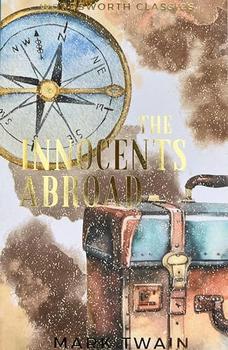
by Mark Twain
The Innocents Abroad by Mark Twain. With an Introduction by Stuart Hutchinson. Who could read the programme for the excursion without longing to make one of the party?
So Mark Twain acclaims his voyage from New York City to Europe and the Holy Land in June 1867. His adventures produced The Innocents Abroad, a book so funny and provocative it made him an international star for the rest of his life. He was making his first responses to the Old World - to Paris, Milan, Florence, Venice, Pompeii, Constantinople, Sebastopol, Balaklava, Damascus, Jerusalem, Nazareth, and Bethlehem. For the first time he was seeing the great paintings and sculptures of the Old Masters . He responded with wonder and amazement, but also with exasperation, irritation, disbelief. Above all he displayed the great energy of his humour, more explosive for us now than for his beguiled contemporaries.
Media reviews not yet available.
This information about The Innocents Abroad (Wordsworth Classics) was first featured
in "The BookBrowse Review" - BookBrowse's membership magazine, and in our weekly "Publishing This Week" newsletter. Publication information is for the USA, and (unless stated otherwise) represents the first print edition. The reviews are necessarily limited to those that were available to us ahead of publication. If you are the publisher or author and feel that they do not properly reflect the range of media opinion now available, send us a message with the mainstream reviews that you would like to see added.
Any "Author Information" displayed below reflects the author's biography at the time this particular book was published.
Mark Twain is the pseudonym of Samuel Langhorne Clemens (1835 - 1910). He was born and brought up in the American state of Missouri and, because of his father's death, he left school to earn his living when he was only twelve. He was a great adventurer and travelled round America as a printer; prospected for gold and set off for South America to earn his fortune. He returned to become a steam-boat pilot on the Mississippi River, close to where he had grown up. The Civil War put an end to steam-boating and Clemens briefly joined the Confederate army - although the rest of his family were Unionists! He had already tried his hand at newspaper reporting and now became a successful journalist. He started to use the alias Mark Twain during the Civil War and it was under this pen name that he became a famous travel writer. He took the name from his steam-boat days - it was the river pilots' cry to let their men know that the water was two fathoms deep.
The Sister's Curse
by Nicola Solvinic

The Lost Story of Eva Fuentes
by Chanel Cleeton

The Vanishing Place
by Zoë Rankin
 (1).gif)
A classic is a book that has never finished saying what it has to say
Click Here to find out who said this, as well as discovering other famous literary quotes!

Can you name the title?
Test your book knowledge with our daily trivia challenge!
Your guide toexceptional books
BookBrowse seeks out and recommends the best in contemporary fiction and nonfiction—books that not only engage and entertain but also deepen our understanding of ourselves and the world around us.