
-
Your next favorite book
is waiting.
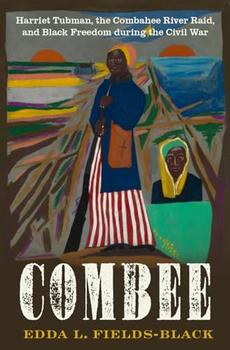
Harriet Tubman, the Combahee River Raid, and Black Freedom during the Civil War
by Edda L. Fields-Black
The story of the Combahee River Raid, one of Harriet Tubman's most extraordinary accomplishments, based on original documents and written by a descendant of one of the participants.
Most Americans know of Harriet Tubman's legendary life: escaping enslavement in 1849, she led more than 60 others out of bondage via the Underground Railroad, gave instructions on getting to freedom to scores more, and went on to live a lifetime fighting for change. Yet the many biographies, children's books, and films about Tubman omit a crucial chapter: during the Civil War, hired by the Union Army, she ventured into the heart of slave territory—Beaufort, South Carolina—to live, work, and gather intelligence for a daring raid up the Combahee River to attack the major plantations of Rice Country, the breadbasket of the Confederacy.
Edda L. Fields-Black—herself a descendent of one of the participants in the raid—shows how Tubman commanded a ring of spies, scouts, and pilots and participated in military expeditions behind Confederate lines. On June 2, 1863, Tubman and her crew piloted two regiments of Black US Army soldiers, the Second South Carolina Volunteers, and their white commanders up coastal South Carolina's Combahee River in three gunboats. In a matter of hours, they torched eight rice plantations and liberated 730 people, people whose Lowcountry Creole language and culture Tubman could not even understand. Black men who had liberated themselves from bondage on South Carolina's Sea Island cotton plantations after the Battle of Port Royal in November 1861 enlisted in the Second South Carolina Volunteers and risked their lives in the effort.
Using previous unexamined documents, including Tubman's US Civil War Pension File, bills of sale, wills, marriage settlements, and estate papers from planters' families, Fields-Black brings to life intergenerational, extended enslaved families, neighbors, praise-house members, and sweethearts forced to work in South Carolina's deadly tidal rice swamps, sold, and separated during the antebellum period. When Tubman and the gunboats arrived and blew their steam whistles, many of those people clambered aboard, sailed to freedom, and were eventually reunited with their families. The able-bodied Black men freed in the Combahee River Raid enlisted in the Second South Carolina Volunteers and fought behind Confederate lines for the freedom of others still enslaved not just in South Carolina but Georgia and Florida.
After the war, many returned to the same rice plantations from which they had escaped, purchased land, married, and buried each other. These formerly enslaved peoples on the Sea Island indigo and cotton plantations, together with those in the semi-urban port cities of Charleston, Beaufort, and Savannah, and on rice plantations in the coastal plains, created the distinctly American Gullah Geechee dialect, culture, and identity—perhaps the most significant legacy of Harriet Tubman's Combahee River Raid.
 Pulitzer Prize, 2025
"Sprawling and kaleidoscopic, this is a marvel of deep research." —Publishers Weekly (starred review)
"A scholarly and remarkable work about enslavement and Civil War...Readers will gain a deeper understanding of that era's times and experiences, and Fields Black's connection to one of the participants makes it a personal work as well." —Library Journal (starred review)
"In her groundbreaking book... Edda Fields-Black tells the rousing story of the Union army's Combahee river raid, which led to the liberation of hundreds of enslaved African-Americans in 1863. Skillfully using pension files and planter records, Ms. Fields-Black...recovers the lives of 'the Combahee freedom seekers through multiple sets of transactions' -records of slave sales, Confederate compensation affidavits and land purchases." —Wall Street Journal
"In COMBEE, Edda Fields-Black gives an underappreciated episode in the history of Harriet Tubman, the Black freedom struggle, and the Civil War the careful and care-full treatment it deserves. More than that, this book brings to light whole worlds contained within a grain of time, lifting up the names and stories of freedom seekers whose voices still resonate powerfully today." —W. Caleb McDaniel, Author of Sweet Taste of Liberty: A True Story of Slavery and Restitution in America, winner of the Pulitzer Prize
This information about COMBEE was first featured
in "The BookBrowse Review" - BookBrowse's membership magazine, and in our weekly "Publishing This Week" newsletter. Publication information is for the USA, and (unless stated otherwise) represents the first print edition. The reviews are necessarily limited to those that were available to us ahead of publication. If you are the publisher or author and feel that they do not properly reflect the range of media opinion now available, send us a message with the mainstream reviews that you would like to see added.
Any "Author Information" displayed below reflects the author's biography at the time this particular book was published.
Dr. Edda L. Fields-Black teaches history at Carnegie Mellon University and has written extensively about the history of West African rice farmers, including in such works as Deep Roots: Rice Farmers in West Africa and the African Diaspora. She was a co-editor of Rice: Global Networks and New Histories, which was selected as a Choice Outstanding Academic Title. Fields-Black has served as a consultant for the Smithsonian National Museum of African-American History and Culture's permanent exhibit, "Rice Fields of the Lowcountry." She is the executive producer and librettist of "Unburied, Unmourned, Unmarked: Requiem for Rice," a widely performed original contemporary classical work by celebrated composer John Wineglass.
Fields-Black is a descendent of Africans enslaved on rice plantations in Colleton County, South Carolina; her great-great-great grandfather fought in the Combahee River Raid in June 1863. Her determination to illuminate the riches of the Gullah dialect, and to reclaim Gullah Geechee history and culture, has taken her to the rice fields of South Carolina and Georgia to those of Sierra Leone and Republic of Guinea in West Africa.

If you liked COMBEE, try these:


 (1).gif)
Asking a working writer what he thinks about critics...
Click Here to find out who said this, as well as discovering other famous literary quotes!

Can you name the title?
Test your book knowledge with our daily trivia challenge!
Your guide toexceptional books
BookBrowse seeks out and recommends the best in contemporary fiction and nonfiction—books that not only engage and entertain but also deepen our understanding of ourselves and the world around us.