
-
Your next favorite book
is waiting.
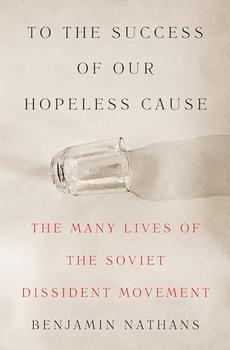
The Many Lives of the Soviet Dissident Movement
by Benjamin Nathans
A "riveting history" (Wall Street Journal) of the Soviet dissident movement, which hastened the end of the USSR and still provides a model of opposition in Putin's Russia—and beyond.
Beginning in the 1960s, the Soviet Union was unexpectedly confronted by a dissident movement that captured the world's imagination. Demanding that the Kremlin obey its own laws, an improbable band of Soviet citizens held unauthorized public gatherings, petitioned in support of arrested intellectuals, and circulated banned samizdat texts. Soviet authorities arrested dissidents, subjected them to bogus trials and vicious press campaigns, sentenced them to psychiatric hospitals and labor camps, sent them into exile—and transformed them into martyred heroes. Against all odds, the dissident movement undermined the Soviet system and unexpectedly hastened its collapse. Taking its title from a toast made at dissident gatherings, To the Success of Our Hopeless Cause is a definitive history of a remarkable group of people who helped change the twentieth century.
Benjamin Nathans's vivid narrative tells the dramatic story of the men and women who became dissidents—from Nobel laureates Andrei Sakharov and Alexander Solzhenitsyn to many others who are virtually unknown today. Drawing on diaries, memoirs, personal letters, interviews, and KGB interrogation records, To the Success of Our Hopeless Cause reveals how dissidents decided to use Soviet law to contain the power of the Soviet state. This strategy, as one of them put it, was "simple to the point of genius: in an unfree country, they began to conduct themselves like free people."
An extraordinary account of the Soviet dissident movement, To the Success of Our Hopeless Cause shows how dissidents spearheaded the struggle to break free of the USSR's totalitarian past, a struggle that continues in Putin's Russia—and that illuminates other struggles between hopelessness and perseverance today.
 Pulitzer Prize, 2025
"Authoritative... . An essential addition to the cultural history of the late Soviet era." ―Kirkus Reviews (starred review)
"An expertly conveyed history of the Soviet dissident movement and the individuals involved. For readers interested in the history of censorship, human rights, international law, or the Soviet Union. It's one not to miss." ―Library Journal (starred review)
"Comprehensive and analytical, Benjamin Nathans's To the Success of Our Hopeless Cause vivifies the Soviet intellectuals at the complex heart of the human-rights-oriented dissidence movement in the USSR... . A meticulous history of a principled movement, To the Success of Our Hopeless Cause addresses efforts to protect human rights within the context of the Soviet Union." ―Foreword Reviews
"[A] thoughtful, superbly researched and gracefully written study of the Russian dissident movement... . [A] riveting history." ―Wall Street Journal
"An exhaustive chronicle of the Soviet dissident movement... . The movement presented a model, Nathans writes, for 'the possibilities for public engagement under circumstances that appeared even more hopeless than our own." ―New York Times
This information about To the Success of Our Hopeless Cause was first featured
in "The BookBrowse Review" - BookBrowse's membership magazine, and in our weekly "Publishing This Week" newsletter. Publication information is for the USA, and (unless stated otherwise) represents the first print edition. The reviews are necessarily limited to those that were available to us ahead of publication. If you are the publisher or author and feel that they do not properly reflect the range of media opinion now available, send us a message with the mainstream reviews that you would like to see added.
Any "Author Information" displayed below reflects the author's biography at the time this particular book was published.
Benjamin Nathans won the 2025 Pulitzer Prize in General Nonfiction for To the Success of Our Hopeless Cause. He is also the author of Beyond the Pale: The Jewish Encounter with Late Imperial Russia, which was awarded the Koret Jewish Book Award, the Vucinich Book Prize, and the Lincoln Book Prize, and was a finalist for the National Jewish Book Award in History. A frequent contributor to the New York Review of Books and the Times Literary Supplement, Nathans is the Alan Charles Kors Associate Professor of History at the University of Pennsylvania.

If you liked To the Success of Our Hopeless Cause, try these:


 (1).gif)
Be careful about reading health books. You may die of a misprint.
Click Here to find out who said this, as well as discovering other famous literary quotes!

Can you name the title?
Test your book knowledge with our daily trivia challenge!
Your guide toexceptional books
BookBrowse seeks out and recommends the best in contemporary fiction and nonfiction—books that not only engage and entertain but also deepen our understanding of ourselves and the world around us.