-
See Our Best Book
Club Books of 2026!
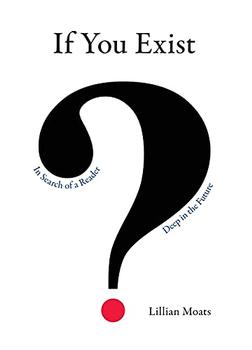
In Search of a Reader Deep in the Future
by Lillian Moats
If You Exist is a personal message written, not to currently living, but rather future descendants, who may find it many generations in the future….
The narrator shares her personal take on where humanity is now and where we might be heading depending on what choices we will make. ... she writes about climate change and such topics as human migration, racism, and the pandemic, as well as her projected concerns about the possibilities of unbridled technical advancement and human redesign.
After offering her perspective on where hope could lie, the writer ends her note with 'the stuff of fairy tales',―her positive fantasy in the final chapter called, 'If We Could Meet.'' —The Humanist
If You Exist is a personal message written to no one living now, but rather to one of our human progeny who might find it many generations in the future. The aging narrator, like others in her generation, faces her own mortality at the same time she faces the possibility of thousands more species, including her own, becoming extinct. She speaks of ''Hunters'' and ''Gatherers'' as she has radically redefined these terms, and applies them to her concerns about the future of Homo sapiens and to the survival of life on our planet.
As a private heartfelt message to someone who may never exist, the writer likens her missive to ''a note in a bottle set to sea in hopes of reaching you, if you exist in the future on some unfathomable shore.'' The narrator shares her personal take on where humanity is now and where we might be heading depending on what choices we will make. Wishing that her imagined reader could answer questions about whether the writer's anxieties have ever been resolved, she writes about climate change and such topics as human migration, racism, the pandemic, as well as her projected concerns about the possibilities of unbridled technical advancement and human redesign.
After offering her perspective on where hope could lie, the writer ends her note with ''the stuff of fairy tales,'' her positive fantasy in the final chapter called, ''If We Could Meet.''
"As she shares her rinsed clean, meticulously ordered thoughts and concerns, Moats handles every word with exquisite care and respect, as though each is a precious stone, a seed, a candle flame. This radiant "note in a bottle" for future generations is the third title in her uniquely gentle yet powerfully discerning set of ethical inquires into the human condition, following The Letter from Death (2009) and Hope: A Myth Reawakened (2015). Here Moats wonders if, decades from now, humankind will still be much like we are or profoundly altered, given the exponential advance of technology and the threatened breakdown of the biosphere. This existentially poignant missive crystallized during the COVID-19 pandemic and the onset of the climate crisis as both ongoing disasters harshly expose intrinsic social inequality and injustice. Moats begins with fresh and provocative definitions for hunting and gathering, reimagining them as two central human impulses. To gather is "to draw close to something, to bring together in a body." To hunt is "to target for killing, or capture." To gather is "inclusive"; to hunt is "exclusive." Moats considers the consequences of each approach as she elucidates how racism and "othering" spur police violence and the unjust and cruel treatment of refugees and immigrants. She also parses the potentially harmful impacts of genetic engineering. Ultimately, Moats expresses the hope that more of us in the here and now will try harder to understand each other and embrace "truth and empathy." ―Booklist
This information about If You Exist was first featured
in "The BookBrowse Review" - BookBrowse's membership magazine, and in our weekly "Publishing This Week" newsletter. Publication information is for the USA, and (unless stated otherwise) represents the first print edition. The reviews are necessarily limited to those that were available to us ahead of publication. If you are the publisher or author and feel that they do not properly reflect the range of media opinion now available, send us a message with the mainstream reviews that you would like to see added.
Any "Author Information" displayed below reflects the author's biography at the time this particular book was published.
Lillian Moats was born in Detroit in 1946. She attended Barnard College and graduated with a B.F.A in art and creative writing from the University of Michigan and an M.S. in education from the University of Wisconsin. She has been an artist throughout her life, expressed in painting, film and illustration. From her mid-twenties through mid-forties, with her creative partner JP Somersaulter, she created over 20 short animated films for children and adults. These original stories and retellings of classic fairy tales have been shown and awarded in festivals around the world and are in the permanent collection of the Chicago Film Archive. Her drive to write rose to the forefront in 1993 and has continued to be her most satisfying creative outlet to the present. She has written a collection of original fairy tales, a fictionalized memoir, a work of creative non-fiction, another of political fiction and now a short philosophical essay with a twist.
The Sister's Curse
by Nicola Solvinic
The Lost Story of Eva Fuentes
by Chanel Cleeton
The Vanishing Place
by Zoë Rankin
 (1).gif)
Censorship, like charity, should begin at home: but unlike charity, it should end there.
Click Here to find out who said this, as well as discovering other famous literary quotes!

Can you name the title?
Test your book knowledge with our daily trivia challenge!
Your guide toexceptional books
BookBrowse seeks out and recommends the best in contemporary fiction and nonfiction—books that not only engage and entertain but also deepen our understanding of ourselves and the world around us.