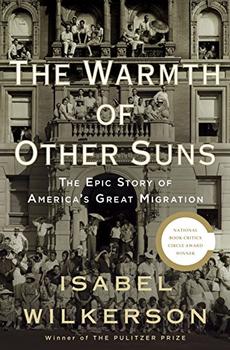
Book Summary and Reviews of The Warmth of Other Suns by Isabel Wilkerson

The Warmth of Other Suns by Isabel Wilkerson

The Warmth of Other Suns

The Epic Story of America's Great Migration

by Isabel Wilkerson

  • Critics' Consensus (3):
  • Readers' Rating (12):
  • Published:
  • Sep 2010, 640 pages
  • Rate this book

About this book

Book Summary

In this epic, beautifully written masterwork, Pulitzer Prize–winning author Isabel Wilkerson chronicles one of the great untold stories of American history: the decades-long migration of black citizens who fled the South for northern and western cities, in search of a better life. From 1915 to 1970, this exodus of almost six million people changed the face of America. Wilkerson compares this epic migration to the migrations of other peoples in history. She interviewed more than a thousand people, and gained access to new data and official records, to write this definitive and vividly dramatic account of how these American journeys unfolded, altering our cities, our country, and ourselves.
 
With stunning historical detail, Wilkerson tells this story through the lives of three unique individuals: Ida Mae Gladney, who in 1937 left sharecropping and prejudice in Mississippi for Chicago, where she achieved quiet blue-collar success and, in old age, voted for Barack Obama when he ran for an Illinois Senate seat; sharp and quick-tempered George Starling, who in 1945 fled Florida for Harlem, where he endangered his job fighting for civil rights, saw his family fall, and finally found peace in God; and Robert Foster, who left Louisiana in 1953 to pursue a medical career, the personal physician to Ray Charles as part of a glitteringly successful medical career, which allowed him to purchase a grand home where he often threw exuberant parties.

Wilkerson brilliantly captures their first treacherous and exhausting cross-country trips by car and train and their new lives in colonies that grew into ghettos, as well as how they changed these cities with southern food, faith, and culture and improved them with discipline, drive, and hard work. Both a riveting microcosm and a major assessment, The Warmth of Other Suns is a bold, remarkable, and riveting work, a superb account of an “unrecognized immigration” within our own land. Through the breadth of its narrative, the beauty of the writing, the depth of its research, and the fullness of the people and lives portrayed herein, this book is destined to become a classic.

Please be aware that this discussion may contain spoilers!

See what our members are saying about this book in our Community Forum.

What are you reading this week? (8/21/2025)
Just finished "The Warmth of Other Suns" by Isabel Wilkerson.
-Judith_Guffey


How do you feel historical fiction can influence the way we look at history?
For me, historical fiction opens up the personal side of history and helps me understand what it was like to live in particular times and places in ways that non-fiction accounts often don't. (One exception is works of narrative non-fiction, such as Isabel Wilkerson's The Warmth of Other Suns, th...
-Kathleen_L


Name three nonfiction books you absolutely loved and would recommend
City on Fire by Bill Minutaglio And the Waters Turned to Blood by Rodney Barker Unbroken by Laura Hillenbrand The Warmth of Other Suns by Isabel Wilkerson A Fever in the Heartland by Timothy Eagan
-Diana_M

Membership Advantages
  • Reviews
  • "Beyond the Book" articles
  • Free books to read and review (US only)
  • Find books by time period, setting & theme
  • Read-alike suggestions by book and author
  • Book club discussions
  • and much more!
  • Just $60 for 12 months or $20 for 3 months.
  • More about membership!

Book Awards

  • award image National Book Critics Circle Awards, 2011

Reviews

Media Reviews

"Starred Review. The drama, poignancy, and romance of a classic immigrant saga pervade this book, hold the reader in its grasp, and resonate long after the reading is done." - Publishers Weekly

"Starred Review." - Kirkus

"Profound, necessary and an absolute delight to read." - Toni Morrison

"The Warmth of Other Suns is a sweeping and yet deeply personal tale of America’s hidden 20th century history - the long and difficult trek of Southern blacks to the northern and western cities. This an epic for all Americans who want to understand the making of our modern nation." - Tom Brokaw

"A seminal work of narrative nonfiction…You will never forget these people." - Gay Talese

This information about The Warmth of Other Suns was first featured in "The BookBrowse Review" - BookBrowse's membership magazine, and in our weekly "Publishing This Week" newsletter. Publication information is for the USA, and (unless stated otherwise) represents the first print edition. The reviews are necessarily limited to those that were available to us ahead of publication. If you are the publisher or author and feel that they do not properly reflect the range of media opinion now available, send us a message with the mainstream reviews that you would like to see added.

Any "Author Information" displayed below reflects the author's biography at the time this particular book was published.

Reader Reviews

Write your own reviewwrite your own review

Cathryn Conroy

A Captivating History Book That Is as Riveting and Compelling as the Best Novels
I am in awe.

I am in awe of author Isabel Wilkerson and her masterful ability to write this impressive epic account.
I am in awe of this remarkable book. If all history books were written like this one, everyone would read history—and love it.
I am in awe of all those who made the Great Migration—for their courage, fortitude, and ability to envision an unknown future in a strange land that was not particularly welcoming.

The Great Migration had no leader. It was not organized. It just happened. One by one they walked away from their homes. Wilkerson describes it as a "leaderless revolution." Over six decades from about 1916 to 1970, about six million Blacks living in the South left the only place they had ever known for various northern and western cities. Some had relatives or friends who had made the journey ahead of them so that is why they escaped to Cleveland or New York or Chicago or Los Angeles, as opposed to any other city. And an escape it was. Escape from harsh conditions, both economic and physical. The Jim Crow laws ensured no Black could ever truly prosper or reach his or her full potential. Lynchings were commonplace and used to terrify Blacks and keep them in their place. Even though they were no longer enslaved, many felt they still had to leave in secrecy under the cloak of darkness or they would be stopped—perhaps violently.

When all these Blacks started leaving the South, the South didn't notice at first until seemingly overnight no one was left to pick cotton or tend the fields. Huh? Where did they all go?

The most riveting part of this book is the focus on three people who made the great migration, whom Wilkerson selected from among 1,200 people she interviewed:
• Ida Mae Brandon Gladney (migrated in 1937), a pregnant sharecropper's wife with two young children, who fled Mississippi for Chicago.
• George Swanson Starling (migrated in 1945), a hotheaded man who was seeking his own form of justice and skipped out of Eustis, Florida for Harlem, New York hours before angry white men wanted to hang him.
• Robert Joseph Pershing Foster, M.D. (migrated in 1953), a surgeon who was not allowed by Louisiana law to practice in a hospital and so he drove all alone across the country to California in search of a place where he could be a physician.

These three never knew each other. Their stories are unconnected. But their stories—what life was like for them in the South, why they made the decision to leave, what happened on their treacherous and long journey north or west, and then how they adapted—are fascinating and the stuff of the best novels. Except it's all true.

Bonus: Be sure to read "Notes on Methodology" at the end of the book, which admittedly sounds very academic, but it's fascinating—and even made me cry at the end.

This is a captivating history book—officially, the genre is called narrative nonfiction—that is as riveting and compelling as the best novels. Highly recommended!

Kelli Robinson

Great Study of the American South
As a Yankee transplant to the South who has lived in Birmingham, Alabama, for nearly 20 years, I found this book fascinating. From the minute I arrived in Alabama, I was acutely aware of the race relations issues still lingering and I found myself studying the history of Alabama especially as it relates to the civil rights movement. One visit to the impressive Birmingham Civil Rights Institute, and its Jim Crow installation including a "White Only" water fountain leaves a lasting impression especially when you walk out the front door and find yourself standing in front of the 16th Street Baptist Church where 4 little girls were murdered in 1963 by a church bomb. Kudos to Ms. Wilkerson and her extensive research which is so eloquently set forth in this book. If I could make this book required reading in every American middle or high school, I would. We may have come a long way since Jim Crow but we still have so far to go and this is the kind of book that opens up the important dialogue necessary between the races to keep the improvement of race relations front and center.

Membership Advantages
  • Reviews
  • "Beyond the Book" articles
  • Free books to read and review (US only)
  • Find books by time period, setting & theme
  • Read-alike suggestions by book and author
  • Book club discussions
  • and much more!
  • Just $60 for 12 months or $20 for 3 months.
  • More about membership!

Author Information

Isabel Wilkerson

Isabel Wilkerson won the 1994 Pulitzer Prize for Feature Writing for her reporting as Chicago bureau chief of The New York Times. The award made her the first black woman in the history of American journalism to win a Pulitzer Prize and the first African American to win for individual reporting. She won the George Polk Award for her coverage of the Midwest and a John Simon Guggenheim Fellowship for her research into the Great Migration. She has lectured on narrative writing at the Nieman Foundation at Harvard University and has served as Ferris Professor of Journalism at Princeton University and as the James M. Cox Jr. Professor of Journalism at Emory University. She is currently Professor of Journalism and Director of Narrative Nonfiction at Boston University. During the Great Migration, her parents journeyed from Georgia and southern Virginia to Washington, D.C., where she was born and reared. This is her first book.

More Author Information

Membership Advantages
  • Reviews
  • "Beyond the Book" articles
  • Free books to read and review (US only)
  • Find books by time period, setting & theme
  • Read-alike suggestions by book and author
  • Book club discussions
  • and much more!
  • Just $60 for 12 months or $20 for 3 months.
  • More about membership!

More Recommendations

Readers Also Browsed . . .

more history, current affairs and religion...

Membership Advantages
  • Reviews
  • "Beyond the Book" articles
  • Free books to read and review (US only)
  • Find books by time period, setting & theme
  • Read-alike suggestions by book and author
  • Book club discussions
  • and much more!
  • Just $60 for 12 months or $20 for 3 months.
  • More about membership!

BookBrowse Book Club

Book Jacket
The Tapestry of Time
by Kate Heartfield

Members Recommend

Who Said...

Beware the man of one book

Click Here to find out who said this, as well as discovering other famous literary quotes!

Book
Trivia

  • Book Trivia

    Can you name the title?

    Test your book knowledge with our daily trivia challenge!

Wordplay

Solve this clue:

W the C A the M W P

and be entered to win..

Your guide toexceptional          books

BookBrowse seeks out and recommends the best in contemporary fiction and nonfiction—books that not only engage and entertain but also deepen our understanding of ourselves and the world around us.