
-
Your next favorite book
is waiting.
Summary | Excerpt | Reviews | Beyond the Book | Readalikes | Genres & Themes | Author Bio
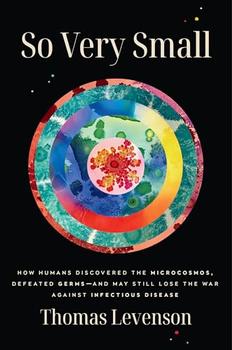
How Humans Discovered the Microcosmos, Defeated Germs--and May Still Lose the War Against Infectious Disease
by Thomas Levenson Book Reviewed by:
I
"God preserve us all"
Few facts remain from the life of good-woman Phillips.
We know this much: She was married. She and her husband lived in the parish of St. Giles in the Fields, just outside London's city wall. The couple had some number of children. Mrs. Phillips fell ill late in December 1664 and died on Christmas Eve. As required, women hired by the parish to review local deaths examined her body. They reported their finding: Phillips, given name unrecorded, had succumbed to the plague.
The usual forms were followed. Her surviving family were shut into their home, given money to cover about a week's worth of food, and quarantined from the community for thirty days. Outside that one household, Phillips's death went almost entirely unnoticed except as an anonymous addition to the weekly Bill of Mortality, the regular report that tallied deaths and their causes parish by parish throughout the capital.
This single case of the plague in what is now the borough of Camden did not spark any immediate concern. In most years, a few cases in different sections of the city formed endemic sparks that then fizzled out. This time, however, the city had reason to stay alert. On the other side of the English Channel, an epidemic outbreak of the plague had been spreading since 1656, beginning in Italy then moving north and west. By the early 1660s it had reached the shores of both the North and Baltic seas—and the ports that traded regularly with England. In London, Charles II's council imposed a quarantine on Dutch shipping in late 1663—but soon sailors were rumored to be escaping from ships at anchor to take their pleasures ashore.
Christmas came and went, and the rest of the Phillips family survived. St. Giles in the Fields recorded no further plague deaths that week, and none were reported in the rest of London. The capital's inhabitants celebrated the holidays, and January began.
Especially for the well connected, London's winter festivals heralded a year full of promise. That irrepressible diarist Samuel Pepys, a senior civilian member of the Navy Board and a confidant to the good and the great, thoroughly enjoyed himself that winter. On December 31 he tallied his accounts for the year and found that "by the great blessing of God, [I am] worth 1349l [pounds], by which, as I have spent very largely, so I have laid up above 500l this yeare above what I was worth this day twelvemonth."
Thus enriched, he allowed himself some treats. On Friday, January 2, he enjoyed a tryst with a woman not his wife, flirted—at least—with another, and then arranged a romp with a third for the coming Sunday. Next came "a most noble French dinner and banquet," after which he walked from Covent Garden to St. Paul's Cathedral. On the north side of the cathedral yard, he found his favorite bookseller's stall and browsed through the latest works. This was Pepys living his best life in the city he loved. He had plenty of ready cash, with more coming in. He relished his daily encounters with the powers in the land—up to and including James Stuart, the future King James II. Before, after, and around his working days, he traveled a constant round of entertainment: good food, fine drink, excellent conversation, a satisfactory marriage, and sexual sport outside that bond whenever (often) the mood took him, all lovingly recounted in his diary. Day after day that winter and into spring, the sheer joy of being Samuel Pepys leaps off the page.
Until, on April 30, 1665, he wrote: "Great fears of the sickness here in the City, it being said that two or three houses are already shut up," adding: "God preserve us all!"
God preserve them! For a brief while longer, this was merely an expression of conventional piety. Most of Pepys's April 30 entry was consumed by a reckoning of wealth that revealed that he was now master of "above 1400£, the greatest sum I ever yet was worth." In the world beyond his diary, though, the plague was on the move. Cases had been reported in the Netherlands the previous year, and English authorities had reimposed restrictions on vessels crossing the North Sea. Some Dutch ships and sailors had evaded those barriers, however, and in late 1664, a few plague deaths were identified at Great Yarmouth on England's east coast. Even under quarantine, exceptions were made for the right people. If important enough interests were at play, Dutch ships that came to London that winter got permission (or were ignored) as they unloaded their cargoes, up to the moment the Anglo-Dutch wars resumed in March 1665. The flow of people and crates from the middle of the Thames to its banks meant that an isolated victim or two along the docks or in the poorer districts would surprise no one. Into April, Londoners had no reason to believe that this season would be any different from those of recent years, when minor flare-ups of disease had burnt themselves out.

Excerpted from So Very Small by Thomas Levenson. Copyright © 2025 by Thomas Levenson. Excerpted by permission of Random House. All rights reserved. No part of this excerpt may be reproduced or reprinted without permission in writing from the publisher.


 (1).gif)
The truth does not change according to our ability to stomach it
Click Here to find out who said this, as well as discovering other famous literary quotes!

Can you name the title?
Test your book knowledge with our daily trivia challenge!
Your guide toexceptional books
BookBrowse seeks out and recommends the best in contemporary fiction and nonfiction—books that not only engage and entertain but also deepen our understanding of ourselves and the world around us.