
-
Your next favorite book
is waiting.
Summary | Excerpt | Reviews | Beyond the Book | Readalikes | Genres & Themes | Author Bio
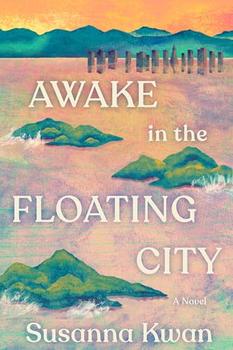
A Novel
by Susanna Kwan Book Reviewed by:
It didn't take long for everything else to follow them up. The school district cordoned off areas for recess and after-school programs. The parks department put on movie nights. Talks, concerts, and community meetings took place under the shelter of portable bandshells. But even then, there was a sense that it wouldn't last. Activity had diminished steadily, as expected, especially in the last two years, and only a third of the vendors remained now. Still, everyone left moved along the roofs, by necessity and for pleasure, for groceries and exercise and socializing, and to get from one place to another.
By habit Bo made her way to the citrus stand, past commemorative murals and cairns, her arm shielding her face from the drops. Her favorite vendor stacked his table with glowing glass jars, a wall of sun against the gray sky. An illusion of bounty. When his greenhouse lemons ripened, he preserved them in salt and oil. He sold them throughout the year, but she rarely bought any; mostly she just came to look.
"Slice some up if you have a pigeon to roast," he'd suggested on her first visit, "or nibble on a sliver if you're craving something sharp." He talked just the right amount, as though sensing correctly that she was unaccustomed to people. Today he said nothing when he saw her but pointed at a basket of finger limes labeled help yourself. She chose one and nodded in thanks. She pushed herself to continue and bought several bundles of spinach from the next table over. They weren't much, but she could stretch them across a few meals before they went bad, delaying her next errand. As she made her way back to the elevator, she estimated she wouldn't have to leave her apartment again for three days.
In the vestibule, she did her ritual scan of the bulletin board, noting any new flyers of the missing and checking for the laminated photo of her mother she had posted two years earlier, just after the big storm. Plain lined face, easy smile, gray pixie cut—it was still there.
Back in her apartment, she laid the food out on a cutting board and played the new message that had come in while she was out: Jenson would ride down on the boat and make the journey back north with her. Those first months after the big storm, he'd begged her to return with him. He'd given her space, said he understood it wasn't easy to leave home. But two years later, her doubts had curdled into paralysis. The situation was dire. Her inaction would be the death of her, he said. He had no choice but to decide for her, to come personally to escort her out.
Not much to do in these final weeks, little to pack, no one to say goodbye to. Now she flattened herself on the floor between the canvases stacked against the wall and the rusted toolbox that held her brushes and knives, paints and rags, lifeless things, none of it touched in over two years, none of it worth taking with her. The clawing inside subsided a little. She did her best to stay perfectly still.
The next week, while she was assessing what to pack, a note slid under her door. I need help, it read. Three days a week, afternoons. Can pay in cash. Signed in a scrawl: Mia, Unit 5109.
The neighbor. For a couple of years, just after the rain began, Bo had been a caregiver for Ricardo, a man who had lived on the fifty-first floor. The old woman who had lived next door to him must have noticed Bo coming and going back then, mops and bags of produce and packs of adult cloth pull-ons in hand.
Patches of the woman's life had come through the walls and windows as Bo had worked: the static from her Cantonese programs, wafts of frying garlic, tones of complaint. Bo had often wondered about her, how she'd come to live alone here, if she had any family, but when she'd asked Ricardo, he'd said he didn't know much. He'd heard from another resident that she'd arrived in America as a young mother in the years following the Second World War, long before he was born. A supercentenarian, they called people like her. A handful of the very old—those who had survived well past a century—were known to live in units throughout their building. Advancements in medicine kept extending life expectancy, but around the world, especially in cities, the elderly found themselves abandoned by family to survive personal and regional crises alone.
Excerpted from Awake in the Floating City by Susanna Kwan. Copyright © 2025 by Susanna Kwan. Excerpted by permission of Pantheon Books. All rights reserved. No part of this excerpt may be reproduced or reprinted without permission in writing from the publisher.


 (1).gif)
Books are the carriers of civilization
Click Here to find out who said this, as well as discovering other famous literary quotes!

Can you name the title?
Test your book knowledge with our daily trivia challenge!
Your guide toexceptional books
BookBrowse seeks out and recommends the best in contemporary fiction and nonfiction—books that not only engage and entertain but also deepen our understanding of ourselves and the world around us.