-
Your next favorite book
is waiting.
Summary | Excerpt | Reviews | Beyond the book | Read-Alikes | Genres & Themes | Author Bio
 Book Reviewed by:
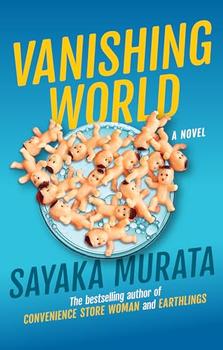
In the alternative version of Japan in Sayaka Murata's Vanishing World, the physical act of sex has become outdated—unnecessary and somewhat taboo. Marriages are purely economic arrangements, and sex between spouses is considered akin to incest; advanced technology means that nearly all children are conceived using artificial insemination. Sexual and romantic desires, Murata writes, are "waste material, something to be disposed of outside the home." Some people channel their desires into obsessions with anime characters; others seek out casual sex from acquaintances to satisfy their needs, with their spouses' full knowledge and support. Most people, however, live a celibate existence.
Amane, Murata's narrator, discovers as a child that she is one of the few people of her generation conceived via the old-fashioned method of "copulation." As she enters adulthood, she becomes fascinated by sex and begins exploring it as a way of forging human connection; and yet she also remains repulsed by the idea that sex led to her creation, internalized self-hatred from years of being told she is "gross" and "disgusting." Eventually she settles into a socially acceptable marriage with a man named Saku. Though their relationship is entirely platonic, the two form a close friendship. When Saku shows a keen interest in the so-called "Experiment City"—where men can carry babies in artificial wombs (see Beyond the Book) and all children remain nameless, raised collectively by the entire community—Amane, who is still struggling to reconcile with her own past, agrees to accompany him there.
In Experiment City, Saku immerses himself in the calm yet clinical way of life that greets them, but Amane is hesitant to integrate. She is disturbed by the indistinguishable children that roam freely, referring to every adult, no matter their gender, as their "mother." The concept of family has been all but erased by Experiment City's communal way of living. Even Saku and Amane's bond begins to fracture, leaving her feeling even more unmoored.
Murata leaves it to the reader to work through their own judgements about the new ways of living that this sci-fi technology, combined with changed social mores, has ushered in. A new world in which anyone might carry a child, in which reproduction didn't depend on women's bodies, could easily be a better one than what came before, in which a wife was simply "an animal with a womb," as Amane calls herself:
"Sometimes when talking with my husband, I would suddenly feel that I wasn't really me, I was just his womb. There was a moment of fear when I wondered whether by chanting the word 'family' over and over and over like a spell, my husband was putting a curse on me to make me into his womb."
Experiment City is, of course, no utopia. Murata crafts a sense of quiet unease; her matter-of-fact prose, translated from the Japanese by Ginny Tapley Takemori, barely belies the disturbing world she's created, absent of the love, intimacy, and emotion that readers associate with family and parenting. And yet Vanishing World regularly reminds the reader that society is constantly evolving, and that we adapt to its changes. What seems normal to us now would have been viewed as heinous in the past. During a confrontation with her mother, who passionately believes society should shift back towards the old ways, Amane thinks:
"I wanted to yell at her that the world she believed was right was only one point on the spectrum between the past and present. We humans were always changing. Whichever world we were brainwashed by, we didn't have the right to judge others based on the ideas we had been inculcated with."
Once something becomes commonplace, anyone can be indoctrinated into a way of living once thought alien. After spending more time in Experiment City, Amane's own resistance begins to crumble:
"Both my husband and I had ingested too much of this world, and we had become normal people here. Normality is the creepiest madness there is. This was all insane, yet it was so right."
In typical Murata fashion, Vanishing World arrives abruptly at a shocking finale. While this swift approach sacrifices some necessary moments of emotional development, the novel's unspoken and painfully human scenarios linger beyond the page, forcing us to consider where we would draw the line in this strange yet plausible world.
 This review
first ran in the May 7, 2025
issue of BookBrowse Recommends.
This review
first ran in the May 7, 2025
issue of BookBrowse Recommends.

If you liked Vanishing World, try these:
by Yoko Tawada
Published 2024
On the heels of Scattered All Over the Earth, Yoko Tawada's new and irresistible Suggested in the Stars carries on her band of friends' astonishing and intrepid adventures.
by Sandra Newman
Published 2024
An imaginative, feminist, and brilliantly relevant-to-today retelling of Orwell's 1984, from the point of view of Winston Smith's lover, Julia, by critically acclaimed novelist Sandra Newman.

by Catherine Lacey
Published 2024
From one of our fiercest stylists, a roaring epic chronicling the life, times, and secrets of a notorious artist.

 (1).gif)
Show me the books he loves and I shall know the man...
Click Here to find out who said this, as well as discovering other famous literary quotes!

Can you name the title?
Test your book knowledge with our daily trivia challenge!
Your guide toexceptional books
BookBrowse seeks out and recommends the best in contemporary fiction and nonfiction—books that not only engage and entertain but also deepen our understanding of ourselves and the world around us.