
-
Your next favorite book
is waiting.
Summary | Excerpt | Reviews | Beyond the book | Read-Alikes | Genres & Themes | Author Bio
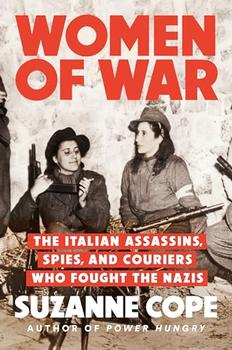
The Italian Assassins, Spies, and Couriers Who Fought the Nazis
by Suzanne Cope Book Reviewed by:
The invasion of Normandy, the Battle of the Bulge, Pearl Harbor—everyone knows these pivotal battles from World War II. Fewer people, however, might be familiar with the battles that led to the 1944 liberation of Rome and Florence, long slogs to drive the Nazi army from Italy. Mussolini's regime had collapsed during the war, and anti-Fascist fighters waged war simultaneously against his rump regime and the Nazis, who were decimating Italy, their erstwhile ally.
Suzanne Cope brings to light this complex facet of an otherwise well-known war in her nonfiction account Women of War: The Italian Assassins, Spies, and Couriers Who Fought the Nazis. But political machinations and military maneuvers are not at the heart of this story. Instead, Cope humanizes the conflict through the experiences of four women who played crucial roles on and off the battlefield, and she shows how women were integral to the fight for freedom and a new political direction in post-Fascist Italy.
The heroines are Carla Capponi, Teresa Mattei, Anita Malavesi, and Bianca Guidetti Serra, who lived and fought in Rome, Florence, Reggio Emilia, and Turin, respectively. Cope tells a braided tale, with chapters focusing on each woman in turn, starting in the 1930s with Mussolini's pact with Hitler.
Mussolini had brought Italy into WWII, but as the Italian population suffered through bombings, military conscription, and wartime deprivations, they became increasingly angry with his regime. This led to Mussolini's arrest in 1943 by opposition forces in the Italian government. Hitler reinstated Mussolini in a puppet regime later that year, and it was at this point that anti-Fascist forces in Italy, who had gone underground for most of Mussolini's rule, began a two-pronged fight against the remnants of Mussolini's regime and the Nazis.
The four women, who didn't know each other and never fought directly together, were hardly more than teenagers in the early 1940s, and their political awakenings happened in those years of the war. Each became part of the Resistance in different ways, whether, like Carla in Rome, through street battles, or, in Bianca's case, via pre-war participation in underground Communist groups. Their activities all began in earnest in 1943 as the Nazi occupation deepened and the forced conscription of Italian soldiers, and deportation of Italian Jews, accelerated.
They started small—running messages, holding clandestine meetings in their homes—but even those small actions could carry a prison sentence or worse. As Cope shows, women were critical to fomenting resistance; because of the ingrained misogyny of the time, many assumed women had no political opinions. This allowed staffette (female couriers) to travel much more easily than men through occupied Italy, and women like Teresa took full advantage by running messages, maps, and munitions to Resistance groups in the Alps. Anita also bicycled through the Apennine Mountains delivering guns, bombs, and staples like food and blankets to guerilla fighters who attacked both Nazis and Italian Fascists.
As the war intensified, so too did women's participation. Carla bombed Nazi strongholds in Rome, Teresa set up the assassination of the mastermind of Italian fascism, Giovanni Gentile, and Anita fled to join resistance fighters in the mountains after being arrested. Each protagonist faced prison time and torture, and some only narrowly escaped. Teresa was brutally raped and beaten before being released.
Yet all four persevered, as did thousands of other women whose names, as Cope acknowledges, have been lost to history. They didn't just fight alongside men; they wrote and published clandestine newspapers arguing for democracy, and they organized workers' strikes to stall the war effort. Bianca, in particular, was a powerful force, fighting with information as well as guns. Cope deftly includes quotes from her 1945 publications to illustrate their forceful arguments for liberation and for women's equal rights—a revolutionary thought at the time.
The narratives build momentum as the Allies slowly pushed the Nazis farther north, and the four women and their comrades could see victory on the horizon. Finally, in April 1945, the Allies and anti-Fascist forces defeated the Nazis and their remaining Fascist collaborators. Women, including our four protagonists, fought against them in the streets until the very end, and even after the war was over, their lives were forever changed by it.
Cope explains how all four women continued fighting for freedom and justice. Carla and Teresa would eventually be elected to Parliament; Teresa is even known as "the mother of the constitution" for her help in writing it. Cope reiterates how important women were to the Resistance even if they didn't participate in combat. They protested, organized, published, and kept Resistance fighters alive through innumerable sacrifices that were equally vital to those of the four protagonists.
The shortness of the chapters that bounce between the women's stories can be jarring at times, and it's occasionally confusing to recall each location and guerilla band the women were working with. But the book's pace mirrors the high stakes they faced, making Women of War a surprisingly quick read despite its density.
For anyone interested in how fascism and totalitarianism are actually brought down, this book will provide an eye-opening lesson in the bravery and equality it takes to achieve victory.
 This review
first ran in the May 7, 2025
issue of BookBrowse Recommends.
This review
first ran in the May 7, 2025
issue of BookBrowse Recommends.

If you liked Women of War, try these:
Looking at Women Looking at War
by Victoria Amelina
Published 2025
Destined to be a classic, a poet's powerful look at the courage of resistance.
by Lena S. Andrews
Published 2024
A groundbreaking new history of the role of American servicewomen in WWII, illuminating their forgotten yet essential contributions to the Allies' victory.
by Judith Mackrell
Published 2023
The riveting, untold history of a group of heroic women reporters who revolutionized the narrative of World War II - from Martha Gellhorn, who out-scooped her husband, Ernest Hemingway, to Lee Miller, a Vogue cover model turned war correspondent.


 (1).gif)
The silence between the notes is as important as the notes themselves.
Click Here to find out who said this, as well as discovering other famous literary quotes!

Can you name the title?
Test your book knowledge with our daily trivia challenge!
Your guide toexceptional books
BookBrowse seeks out and recommends the best in contemporary fiction and nonfiction—books that not only engage and entertain but also deepen our understanding of ourselves and the world around us.