
-
Your next favorite book
is waiting.
Summary | Excerpt | Reviews | Beyond the book | Read-Alikes | Genres & Themes | Author Bio
 Book Reviewed by:
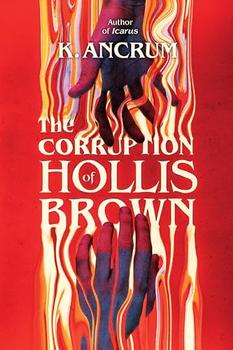
"Corruption" seems like an accurate way to refer to the possession of a person's body against their will, which is what happens to the titular character in K. Ancrum's young adult novel The Corruption of Hollis Brown. The word could also gesture to the chilling history of the book's setting, a rural Michigan town shaped by a past of enforced poverty and family-run organized crime. At the opening of the story, this history surrounds disgruntled teenager Hollis, who lives with his parents in this place left behind following a mythical, uneven time of American prosperity, a place where people commute for hours to work, where high school students have a hard future ahead of them without the promise of a college scholarship. Then, when his body is taken over by Walt, the ghost of a boy who lived in the 1920s, the past is literally in him.
Unlike the static circumstances in which Hollis has spent his youth, Walt is in flux. A wandering spirit who needs a host to survive, he infiltrates Hollis as he's walking home one night, an act necessarily violent in its force. But the two soon begin to communicate, negotiate, and even understand each other — albeit with plenty of friction — through the thoughts they share (with their "dialogue" rendered for the reader in contrasting bold and italicized text). This leads to drama involving Rose Town, an industrial settlement mostly left alone by present-day residents of the area; and romance, as Hollis's longstanding unrequited attraction to his friend Annie Watanabe begins to shift in a different direction.
The Corruption of Hollis Brown is not so much a genuinely scary story as one that uses elements of horror and the supernatural to paint an enhanced portrait of life for young rural people abandoned by the contemporary world. The harshness of the setting easily blends with adolescent angst. Hollis has been carrying general feelings of frustration and depression since long before Walt came on the scene; he often gets into fights, which Annie and their friend Yulia Egunyemi berate him for ("The thing about being friends with only girls was that they held him accountable for his actions"); and he has a quasi-suicidal habit of standing dangerously close to the tracks as a train rips past.
The resourcefulness of Hollis's family, their ability to redefine and beautify the bleakness around them, seems intertwined with the inventiveness of the book's diverse cast of young queer people discovering themselves and each other, exploring possibilities for relationships, gender roles, and ways of being that are not necessarily clearly modeled for them. This inventiveness extends to the larger community, as Hollis dreams, rather than of escaping, of helping his town attain self-sufficiency through sustainable means. The cozier parts of the story — tender confidences between friends, Hollis and his mother saving on groceries with baking, cheesemaking, and preserving — are the building blocks for its vividly harmonious world; and as Hollis makes mozzarella and pays Yulia back for her kindnesses to him with sweet potato bread, readers can follow along with recipes Ancrum provides.
The novel clocks in at nearly 400 pages but comes in an accessible presentation, with short chapters that leave beats of white space in between. Like Ancrum's previous novel Icarus, this book focuses on bodily intimacy, taking it to a new level with the concept of negotiating privacy, touch, and eroticism between two consciousnesses in one human form. Her minimalist writing style, which often forgoes description and immerses the reader in character, action, and dialogue, creates space for the immediacy of Hollis's physical world and emphasizes what a strange, jarring, and beautiful experience it is to exist in a body over a lifetime — even while not sharing one with a ghost.
Despite its relative lack of description, The Corruption of Hollis Brown leaves the reader with the impression of a delicate series of images. It is romantic in nearly every sense of the word, and buzzes with understated drama. With insights to impart about queerness, family, masculinity, community, and baked goods, it pulls social commentary and history into the sweet, bold story of a boy and his loved ones.
 This review
first ran in the May 21, 2025
issue of BookBrowse Recommends.
This review
first ran in the May 21, 2025
issue of BookBrowse Recommends.

If you liked The Corruption of Hollis Brown, try these:

by Wen-yi Lee
Published 2025
From Gillian Flynn Books, a lyrical young adult horror by debut author Wen-yi Lee that's perfect for fans of She Is a Haunting, Stephen King's IT, and The Haunting of Hill House.
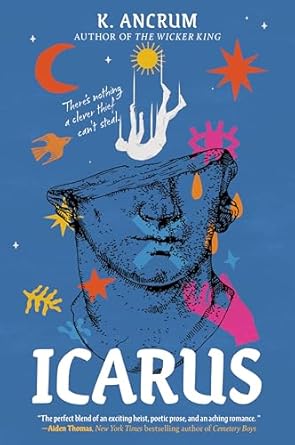
by K. Ancrum
Published 2025
Perfect for fans of Adam Silvera and Aristotle and Dante Discover the Secrets of the Universe, this suspenseful queer YA romance from critically acclaimed author K. Ancrum reimagines the tale of Icarus as a star-crossed love story between a young art thief and the son of the man he's been stealing from—think Portrait of a Thief for YA readers...

by Adam Silvera
Published 2016
Adam Silvera's extraordinary debut confronts race, class, and sexuality during one charged near-future summer in the Bronx.

 (1).gif)
Idealism increases in direct proportion to one's distance from the problem.
Click Here to find out who said this, as well as discovering other famous literary quotes!

Can you name the title?
Test your book knowledge with our daily trivia challenge!
Your guide toexceptional books
BookBrowse seeks out and recommends the best in contemporary fiction and nonfiction—books that not only engage and entertain but also deepen our understanding of ourselves and the world around us.