Page 1 of 1
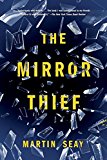
There are currently 2 reader reviews for The Mirror Thief
Write your own review!
Lynda A Abshire
Long but Fascinating Read
When I began this book, I had no idea of its length, but it kept me intrigued for days. The very idea of these three related stories, all in a locale with Venice as its name, but not the same locale was clever. The characters I became very fond of in all three stories and desperately read on to find out what might happen to them in the end. The hint of magic in the pages of Welle's book was delicious as was the glimpse of Venice in the 1500's. I will look forward to this writer's next novel.
P.J. Barry
Reflections on the Mirror Thief
Martin Seay's "The Mirror Thief" is an ambitious telling of three separate but inter-related tales. The stories take place in three Venices: the Italian city in 1592, the California city in 1958, and a hotel of that name in Las Vegas in 2003. The strength of each story was the compelling protagonist in each.
in 1592, Crivano is involved in an intrigue at the behest of a sultan where he is trying to export the much coveted Venetian mirror making technology to Constantinople. If he is caught doing so death is his reward. In 1958, the man known as Stanley Glass is a young hustler searching for the author of a book of poetry which he believes holds the keys to magic that he senses just beyond his reach. Both men are Machiavellian and believes that they are only seeing part of the world. By contrast Curtis, the protagonist in 2003, is literally only seeing half of the world as he lost an eye in the police action in Kosovo. His quest is to find the now old sick Stanley for a man he hopes will eventually hire him for a permanent security position at a casino.
The research that must have went into undertaking is staggering. It is easy to understand how the book took 6 years to write. I find it amazing that this was the author's first effort at a novel. The research did expose my lack of knowledge at times, particularly in the 16th century Venice section. At times I wished for an annotated edition like my college Shakespeare textbook which explained exactly what a reference in his play meant. But this did not distract from the reading too much as the stories were suspenseful and kept the pages turning.
The writing style in each story were different. the 2003 tale moved like a fast paced modern who done it. The 1958 tale was also fast paced but interspaced with off beat characters that helped evoke the period of the beat generation. The 1592 tale was dark and brooding and very meaty. It demanded concentration to be able to follow all the intrigue and characters facing Crivano.
This book is very cerebral. If you are looking for a light read, this is not for you. But if you enjoy complexity, and dwelling upon what an author is saying you will find this a remarkable read. I plan to reread this story. I have a hunch that more will be revealed on a second reading that I might have missed the first time through.

 Book Reviewed by:
 (1).gif)