-
Your next favorite book
is waiting.
Summary | Excerpt | Reading Guide | Reviews | Beyond the book | Read-Alikes | Genres & Themes | Author Bio
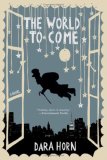
 Book Reviewed by:
With astonishing grace and simplicity, Dara Horn interweaves a real art heist, history, biography, theology, and Yiddish literature. Richly satisfying, utterly unique, her novel opens the door to "the world to come"—not life after death, but the world we create through our actions right now.
A million-dollar painting by Marc Chagall is stolen from a museum. The unlikely
thief is Benjamin Ziskind, a thirty-year-old quiz-show writer. As Benjamin and
his twin sister try to evade the police, they find themselves recalling their
dead parents—the father who lost a leg in Vietnam, the mother who created
children's books—and their stories about trust, loss, and betrayal.
What is true, what is fake, what does it mean? Eighty years before the theft,
these questions haunted Chagall and the enigmatic Yiddish fabulist Der Nister
("The Hidden One"), teachers at a school for Jewish orphans. Both the painting
and the questions will travel through time to shape the Ziskinds' futures.
With astonishing grace and simplicity, Dara Horn interweaves a real art heist,
history, biography, theology, and Yiddish literature. Richly satisfying, utterly
unique, her novel opens the door to "the world to come"—not life after death,
but the world we create through our actions right now.
There used to be many families like the Ziskinds, families where
each person always knew that his life was more than his alone. Families like
that still exist, but because there are so few of them, they have become
insular, isolated, their sentiment that the family is the center of the universe
broadened to imply that nothing outside the family is worth anything. If you are
from one of these families, you believe this, and you always will.
Lately it had begun to seem to Benjamin Ziskind that the entire
world was dead, that he was a citizen of a necropolis. While his parents were
living, Ben had thought about them only when it made sense to think about them,
when he was talking to them, or talking about them, or planning something
involving them. But now they were always here, reminding him of their presence
at every moment. He saw them in the streets, always from behind, or turning a
corner, his father sitting in the bright yellow taxi next to his, shifting in
...
Some books are amusing enough to read at the time, but lacking true substance, quickly fade from my mind. It's been some weeks since I finished The World to Come and I can safely say that this is not going to be one of those books! Dara Horn (author of In the Image, 2002) has produced a real gem of a book with a wealth of plots and sub-plots, packed full with everything from Yiddish folklore to Soviet politics. However, it is not a book that all will appreciate - I'm thinking here of readers who like their books to end neatly with all plot elements tidied up and put away. This is not such a book - without spoiling the plot, all I can say is the ending is in keeping with the Chagall painting at the center of the story!..continued
Full Review
 (384 words)
(Reviewed by BookBrowse Review Team).
 Binnie Kirshenbaum, author of An Almost Perfect Moment
Like a spider weaving her web -- miraculously -- Dara Horn weaves the poignant stories of lives past, lives present, and lives to come in this splendid tale of storytelling itself. A terrific yarn peopled with tender and very human characters, a page-turning mystery of the best sort: not who done it, but why. Melvin Jules Bukiet, author of Strange Fire and A Faker's Dozen
Some excellent books are smart and serious; others are sweet and joyous. Amazingly, Dara Horn's The World to Come is all of the above. Ms. Horn hits every note in the literary register from historical tragedy to mystical delirium, and plays them like a master. Steve Stern, author of The Angel of Forgetfulness
I can't even count the ways I admire The World to Come -- everything about
the book intoxicated me. It is quite simply an astonishing achievement, and Dara
Horn is the realist of real things. I suspect it'll be a long while before I
again read a book as true as The World to Come.
Binnie Kirshenbaum, author of An Almost Perfect Moment
Like a spider weaving her web -- miraculously -- Dara Horn weaves the poignant stories of lives past, lives present, and lives to come in this splendid tale of storytelling itself. A terrific yarn peopled with tender and very human characters, a page-turning mystery of the best sort: not who done it, but why. Melvin Jules Bukiet, author of Strange Fire and A Faker's Dozen
Some excellent books are smart and serious; others are sweet and joyous. Amazingly, Dara Horn's The World to Come is all of the above. Ms. Horn hits every note in the literary register from historical tragedy to mystical delirium, and plays them like a master. Steve Stern, author of The Angel of Forgetfulness
I can't even count the ways I admire The World to Come -- everything about
the book intoxicated me. It is quite simply an astonishing achievement, and Dara
Horn is the realist of real things. I suspect it'll be a long while before I
again read a book as true as The World to Come.Dara Horn was
inspired to write The World
To Come following an actual
theft of a Marc Chagall painting
from a museum in New York that
took place during a singles'
cocktail hour.
More about this.
The painting that Benjamin
Ziskind steals from the museum,
Study for "Over Vitebsk",
is, I assume, fictitious.
However
Over Vitebsk itself does
exist, and can be seen in the
Museum of Modern Art (MOMA) in
New York. Vitebsk was the town
in which Chagall was born and
...
If you liked The World To Come, try these:
36 Arguments for the Existence of God
by Rebecca Goldstein
Published 2011
A hilarious, heartbreaking, and intellectually captivating novel about the rapture and torments of religious experience in all its variety.
by Geraldine Brooks
Published 2009
From the Pulitzer Prize–winning author of March, the journey of a rare illuminated manuscript through centuries of exile and war.

by Amy Bloom
Published 2008
When her family is destroyed in a Russian pogrom, Lillian comes to America alone, determined to make her way in a new land. When word comes that her daughter, Sophie, might still be alive, Lillian embarks on an odyssey that takes her from the world of the Yiddish theater on New York’s Lower East Side, to Seattle’s Jazz District, and up to...
 (1).gif)
Children are not the people of tomorrow, but people today.
Click Here to find out who said this, as well as discovering other famous literary quotes!

Can you name the title?
Test your book knowledge with our daily trivia challenge!