-
Your next favorite book
is waiting.
Summary | Excerpt | Reading Guide | Reviews | Beyond the book | Read-Alikes | Genres & Themes | Author Bio

A Novel
by James Morrow Book Reviewed by:
Jennet Stearne's father hangs witches for a living in Restoration England. But when this precocious child witnesses the horrifying death of her beloved Aunt Isobel, unjustly executed as a sorceress, she makes it her life's mission to bring down the Parliamentary Witchcraft Act.
From a writer who has been lauded as "an original -- stylistically ingenious, savagely funny, always unpredictable" (Philadelphia Inquirer) and "unerring" (San Diego Union-Tribune), who has been compared to Mark Twain, Kurt Vonnegut, and John Updike, a writer whose pen has given us a devastating lampoon of the nuclear-arms race and an audacious answer to the outrageous question "What if God had a daughter?" -- from this writer, the critically acclaimed James Morrow, comes a novel of history, adventure, science, sex, satire, absurdity, and philosophy.
Jennet Stearne's father hangs witches for a living in Restoration England. But when this precocious child witnesses the horrifying death of her beloved Aunt Isobel, unjustly executed as a sorceress, she makes it her life's mission to bring down the Parliamentary Witchcraft Act. A self-educated "natural philosopher," Jennet is inspired in her quest by a single sentence in a cryptic letter from Isaac Newton: It so happens that in the Investigations leading first to my Conjectures concerning Light and later to my System of the World, I fell upon a pretty Proof that Wicked Spirits enjoy no essential Existence. Armed with nothing but the power of reason and her memory of Isobel's love, Jennet cannot rest until she has put the last witchfinder out of business.
Abrim with picaresque adventures -- escapades that carry Jennet from King William's Britain to the fledgling American Colonies to an uncharted Caribbean island -- our heroine's search for justice entangles her variously in the machinations of the Salem Witch Court, the customs of her Algonquin Indian captors, the designs of a West Indies pirate band, and the bedsheets of her brilliant lover, the young Ben Franklin. Finally, in a reckless and courageous ploy, Jennet arranges to go on trial herself for sorcery, the only way she can defeat the witchfinders now and forever. Rich in detail, rollicking in style, and endlessly engaging, The Last Witchfinder is a tour de force of historical fiction.
Whose
Father Hunts Witches,
Whose
Aunt Seeks Wisdom,
and
Whose Soul Desires
an
Object
It
Cannot Name
May I speak candidly, fleshling,
one rational creature to another, myself a book and you a reader? Even if the
literature of confession leaves you cold, even if you are among those who wish
that Rousseau had never bared his soul and Augustine never mislaid his shame,
you would do well to lend me a fraction of your life. I am Mathematical
Principles of Natural Philosophy, after all—in my native tongue, Philosophiæ
Naturalis Principia Mathematica, the Principia for short—not some
tenth-grade algebra text or guide to improving your golf swing. Attend my
adventures and you may, Dame Fortune willing, begin to look upon the world anew.
Unlike you humans, a book always
remembers its moment of conception. My father, the illustrious Isaac Newton,
having abandoned his studies at Trinity College to escape the great plague of
1665, was spending the summer at his ...
According to his publisher, Morrow's latest book took nine years to write - set in the 17th-century, it's a richly detailed, cerebral tale narrated by Isaac Newton's Principia Mathematica (more about this in the sidebar). This is a book that you're likely to either love or hate. According to one of the book blurbs, written by Peter Straub (author of Ghost Story and Shadowland) fans of Neal Stephenson, John Barth and Thomas Pynchon will enjoy this, another reviewer compares Morrow to John Barth, and, in the past, he has been compared to writers such as Kurt Vonnegut and John Updike...continued
Full Review
 (525 words)
(Reviewed by BookBrowse Review Team).
 John Crowley, author of Lord Byron's Novel
Witty, scary,
multifarious, and hilarious. The Last Witchfinder has the
pitiless clarity of the age it pictures, leavened by Morrow’s smiling,
humane historical imagination: like being tied to the stake and
mercifully released. It will win James Morrow a wide readership, and
should. Neal Stephenson, author of The Baroque Cycle
A grand yarn about the clash of reason and superstition, set in a fascinating time. Peter Straub, author of Ghost Story and Shadowland
Combining extravagant quantities of both warmth and brilliance, James Morrow's The Last Witchfinder should speak directly to everyone who loves the work of Neal Stephenson, John Barth, or Thomas Pynchon. But its wild humor, knock 'em dead pace, shining intelligence, and surpassing tenderness toward its characters ought to entice readers of every kind into its glorious big tent. With this book, James Morrow has broken through to a new and breathtaking mastery.
John Crowley, author of Lord Byron's Novel
Witty, scary,
multifarious, and hilarious. The Last Witchfinder has the
pitiless clarity of the age it pictures, leavened by Morrow’s smiling,
humane historical imagination: like being tied to the stake and
mercifully released. It will win James Morrow a wide readership, and
should. Neal Stephenson, author of The Baroque Cycle
A grand yarn about the clash of reason and superstition, set in a fascinating time. Peter Straub, author of Ghost Story and Shadowland
Combining extravagant quantities of both warmth and brilliance, James Morrow's The Last Witchfinder should speak directly to everyone who loves the work of Neal Stephenson, John Barth, or Thomas Pynchon. But its wild humor, knock 'em dead pace, shining intelligence, and surpassing tenderness toward its characters ought to entice readers of every kind into its glorious big tent. With this book, James Morrow has broken through to a new and breathtaking mastery.James Morrow describes himself as a 'scientific humanist'. His earlier works tend to question religious viewpoints, from organized religions all the way through to atheism. For example, in the first volume of his Godhead Trilogy, written in the 1990s, the 2-mile long corpse of God is discovered floating in the ocean and the Vatican dispatches a supertanker to tow the corpse to a tomb in the Arctic, meanwhile a group of atheist extremists plan on destroying the body, as it proves they were wrong. In the second volume, God's body is now part of a religious theme ...
If you liked The Last Witchfinder, try these:
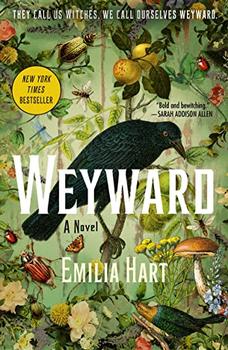
by Emilia Hart
Published 2024
Weaving together the stories of three extraordinary women across five centuries, Emilia Hart's Weyward is an enthralling novel of female resilience and the transformative power of the natural world.
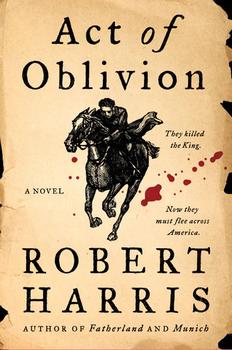
by Robert Harris
Published 2023
From the bestselling author of Fatherland, The Ghostwriter, Munich, and Conclave comes this spellbinding historical novel that brilliantly imagines one of the greatest manhunts in history: the search for two Englishmen involved in the killing of King Charles I and the implacable foe on their trail - an epic journey into the wilds of seventeenth-...
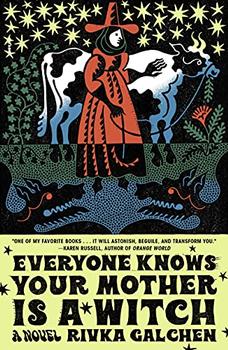
Everyone Knows Your Mother Is a Witch
by Rivka Galchen
Published 2022
The startling, witty, highly anticipated second novel from the critically acclaimed author of Atmospheric Disturbances.
 (1).gif)
It is a fact of life that any discourse...will always please if it is five minutes shorter than people expect
Click Here to find out who said this, as well as discovering other famous literary quotes!

Can you name the title?
Test your book knowledge with our daily trivia challenge!