
-
Your next favorite book
is waiting.
Summary | Excerpt | Reviews | Beyond the book | Read-Alikes | Genres & Themes | Author Bio
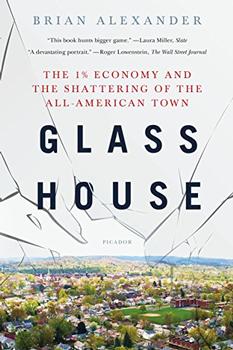
The 1% Economy and the Shattering of the All-American Town
by Brian Alexander Book Reviewed by:
In 1947, Forbes magazine declared Lancaster, Ohio the epitome of the all-American town. Today it is damaged, discouraged, and fighting for its future.
In Glass House, journalist Brian Alexander uses the story of one town to show how seeds sown 35 years ago have sprouted to give us Trumpism, inequality, and an eroding national cohesion.
The Anchor Hocking Glass Company, once the world's largest maker of glass tableware, was the base on which Lancaster's society was built. As Glass House unfolds, bankruptcy looms. With access to the company and its leaders, and Lancaster's citizens, Alexander shows how financial engineering took hold in the 1980s, accelerated in the 21st Century, and wrecked the company. We follow CEO Sam Solomon, an African-American leading the nearly all-white town's biggest private employer, as he tries to rescue the company from the New York private equity firm that hired him. Meanwhile, Alexander goes behind the scenes, entwined with the lives of residents as they wrestle with heroin, politics, high-interest lenders, low wage jobs, technology, and the new demands of American life: people like Brian Gossett, the fourth generation to work at Anchor Hocking; Joe Piccolo, first-time director of the annual music festival who discovers the town relies on him, and it, for salvation; Jason Roach, who police believed may have been Lancaster's biggest drug dealer; and Eric Brown, a local football hero-turned-cop who comes to realize that he can never arrest Lancaster's real problems.
INTRODUCTION
The CEO
Sam Solomon drove his rental car through the west side, pulled into the rutted parking lot across the street from the offices on Pierce Avenue, opened his door, and heard air compressors whooshing, machines clanking, furnaces roaring. The factory adjacent to the offices groaned and heaved like an old man getting up out of his Barcalounger.
This was the heart and soul of EveryWare Global, a company with a name of pretend grandiosity that managed to be both redundant and generic. Solomon was about to start his first day as interim CEO.
He'd signed his new employment contract a few days before, on February 21, 2014: a Friday. That Sunday, he flew in from Chicago to EveryWare's headquarters in Lancaster, Ohio, because he wanted to get an early Monday morning start. But upon arriving in Ohio, Solomon received a call waving him off: Don't come in Monday. Officials from Monomoy Capital Partners, the New York private equity outfit that owned most of EveryWare&#...
Everything is connected, however, as Alexander repeatedly reinforces, which is why Glass House should be essential reading for anyone concerned about the future of American workers – regardless of what town we call home...continued
Full Review
 (581 words)
(Reviewed by Norah Piehl).
 Beth Macy, author of Factory Man and (forthcoming) Truevine
Part sociological study and part investigative business reporting, this book should be required reading for people trying to understand Trumpism, inequality, and the sad state of a needlessly wrecked rural America. I wish I had written it. Donald Ray Pollock, author of The Heavenly Table and The Devil All the Time
Glass House is a fascinating, multi-layered, and superbly written account of how politics, corporate greed, low wages, and the recent heroin epidemic have nearly destroyed a once prosperous Midwestern city. This is a must read for anyone interested in really understanding the anger and frustration of blue collar workers and the middle class in America today. Stephanie Coontz, author of The Way We Never Were: American Families and the Nostalgia Trap
A compassionate but clear-eyed description of how deindustrialization, financial speculation, union-busting and deregulation undermined the social fabric of Alexander's home town, illustrated with gripping personal stories. Timothy Noah, author of The Great Divergence: America's Growing Inequality Crisis and What We Can Do About It
Brian Alexander's Glass House dramatizes vividly how a half-century of economic 'progress' dismantled America's once-sturdy middle class. By focusing his narrative on the inhabitants of Lancaster, Ohio, Alexander personalizes this familiar story in a compelling, often surprising, and utterly heartbreaking way. Victor Fleischer, Professor of Law, University of San Diego, and New York Times columnist
Glass House is a compelling and harrowing look at the corrosion of the social and economic institutions that once held us all together, from the corporate boardroom to the factory floor. It's the most heartbreaking tale of a city since Mike Davis's City of Quartz.
Beth Macy, author of Factory Man and (forthcoming) Truevine
Part sociological study and part investigative business reporting, this book should be required reading for people trying to understand Trumpism, inequality, and the sad state of a needlessly wrecked rural America. I wish I had written it. Donald Ray Pollock, author of The Heavenly Table and The Devil All the Time
Glass House is a fascinating, multi-layered, and superbly written account of how politics, corporate greed, low wages, and the recent heroin epidemic have nearly destroyed a once prosperous Midwestern city. This is a must read for anyone interested in really understanding the anger and frustration of blue collar workers and the middle class in America today. Stephanie Coontz, author of The Way We Never Were: American Families and the Nostalgia Trap
A compassionate but clear-eyed description of how deindustrialization, financial speculation, union-busting and deregulation undermined the social fabric of Alexander's home town, illustrated with gripping personal stories. Timothy Noah, author of The Great Divergence: America's Growing Inequality Crisis and What We Can Do About It
Brian Alexander's Glass House dramatizes vividly how a half-century of economic 'progress' dismantled America's once-sturdy middle class. By focusing his narrative on the inhabitants of Lancaster, Ohio, Alexander personalizes this familiar story in a compelling, often surprising, and utterly heartbreaking way. Victor Fleischer, Professor of Law, University of San Diego, and New York Times columnist
Glass House is a compelling and harrowing look at the corrosion of the social and economic institutions that once held us all together, from the corporate boardroom to the factory floor. It's the most heartbreaking tale of a city since Mike Davis's City of Quartz. At one point in Glass House, Brian Alexander describes his childhood experience of peering into one of the glass manufacturing plants in his home town: "Nuns had spent years engraving images of hell on my imagination. The flames shooting out of the squat stack on the roof, the white-red glow of the furnace inside, the gray shadows of the men hoisting their gatherers to collect glass from the inferno sure looked like hell." Even in the twenty-first century, glassmaking is a hot and sometimes dangerous occupation, one with a history that is thousands of years old.
 According to a (scientifically dubious) account by the Roman historian Pliny, glassmaking was discovered accidentally, when Phoenician sailors heated their cooking pots and ...
If you liked Glass House, try these:

by Eric Eyre
Published 2021
From a Pulitzer Prize–winning reporter from the smallest newspaper ever to win the prize in the investigative reporting category, an urgent, riveting, and heartbreaking investigation into the corporate greed that pumped millions of pain pills into small Appalachian towns, decimating communities.
by J.D. Vance
Published 2018
#1 New York Times Bestseller, named by the Times as one of the "6 books to help understand Trump's win"

by Arlie Russell Hochschild
Published 2018
2016 National Book Award Finalist for Nonfiction
A 2016 New York Times Notable Book
New York Times Bestseller


 (1).gif)
Beware the man of one book
Click Here to find out who said this, as well as discovering other famous literary quotes!

Can you name the title?
Test your book knowledge with our daily trivia challenge!