-
Your next favorite book
is waiting.
Summary | Excerpt | Reading Guide | Reviews | Beyond the book | Read-Alikes | Genres & Themes | Author Bio

How Two Pioneering Sisters Brought Medicine to Women and Women to Medicine
by Janice P. Nimura Book Reviewed by:
Elizabeth Blackwell believed from an early age that she was destined for a mission beyond the scope of "ordinary" womanhood.
Though the world at first recoiled at the notion of a woman studying medicine, her intelligence and intensity ultimately won her the acceptance of the male medical establishment. In 1849, she became the first woman in America to receive an M.D. She was soon joined in her iconic achievement by her younger sister, Emily, who was actually the more brilliant physician.
Exploring the sisters' allies, enemies, and enduring partnership, Janice P. Nimura presents a story of trial and triumph. Together, the Blackwells founded the New York Infirmary for Indigent Women and Children, the first hospital staffed entirely by women. Both sisters were tenacious and visionary, but their convictions did not always align with the emergence of women's rights―or with each other. From Bristol, Paris, and Edinburgh to the rising cities of antebellum America, this richly researched new biography celebrates two complicated pioneers who exploded the limits of possibility for women in medicine. As Elizabeth herself predicted, "a hundred years hence, women will not be what they are now."
Excerpt
The Doctors Blackwell
The world knows Elizabeth Blackwell as the first woman in America to receive a medical degree, in 1849. Her sister Emily joined her in that distinction in 1854. Their achievements, including the foundation of the first hospital run by and for women, are enshrined in American history.
But in 1845, before Elizabeth became an icon, she was a bored and frustrated 24-year-old, teaching to help support her mother and eight siblings in Cincinnati. It was at this stalled moment that a terminally ill friend planted the seed of an idea. "If I could have been treated by a lady doctor," the woman confided, "my worst sufferings would have been spared me."
Elizabeth scoffed. Why would a young woman enthralled by literature and philosophy suddenly apply her considerable ambition to what was, essentially, still a trade—and not even a lucrative one? Not to mention there was no such thing as a female physician, at least in any honorable sense. Women who claimed that...
I enjoyed reading about the lives and times of the Blackwell sisters, but found my interest waning in the middle of the book as Emily's story began to emerge more fully. Many of the problems she encountered were so similar to Elizabeth's that it felt repetitive. Adding to that, the author was able to locate Elizabeth's journals, so her thoughts and attitudes were well-documented; that level of detail seems to have been unavailable for Emily, giving her less depth. The Doctors Blackwell is recommended for readers who enjoy biographies, history, and books about trailblazing women. Reading groups will also find many good topics of conversation here...continued
Full Review
 (662 words)
(Reviewed by Kim Kovacs).
 Danielle Ofri, American Scholar
Nimura writes fluidly, and her book is an engaging and meticulously documented guide not only to the sisters' lives but also to the medical practices of their time. We hear about obsolete medical treatments (intravaginal leeches), student ingenuity (stuffing medical textbooks under clothes to avoid paying taxes) and New York trivia (the Blackwell's infirmary on Bleecker Street was a former Roosevelt residence). But the greater part of Nimura's achievement lies in how she brings new life to the story of two extraordinary and idiosyncratic physicians who forever changed the medical profession. Megan Marshall, Pulitzer Prize–winning author of Margaret Fuller: A New American Life
The Doctors Blackwell should be required reading in all medical schools, indeed for anyone who has ever consulted a doctor. This rousing story of two brilliant and determined nineteenth-century sisters is also a history of American medicine?how it was practiced and by whom. That the Blackwells arrived in the United States during a cholera epidemic and made it their mission to provide medical care to the underserved, while also promoting the twin causes of women's rights and abolition, brings this narrative hurtling into the twenty-first century, demanding our attention today. Perri Klass, author of A Good Time to Be Born
All doctors and all patients owe a debt to these eccentric, determined, brilliant characters, Elizabeth and Emily Blackwell, who found their way across the strange and bloody landscape of nineteenth-century medicine and transformed it forever, all brilliantly conjured in Janice P. Nimura's wonderful book.
Danielle Ofri, American Scholar
Nimura writes fluidly, and her book is an engaging and meticulously documented guide not only to the sisters' lives but also to the medical practices of their time. We hear about obsolete medical treatments (intravaginal leeches), student ingenuity (stuffing medical textbooks under clothes to avoid paying taxes) and New York trivia (the Blackwell's infirmary on Bleecker Street was a former Roosevelt residence). But the greater part of Nimura's achievement lies in how she brings new life to the story of two extraordinary and idiosyncratic physicians who forever changed the medical profession. Megan Marshall, Pulitzer Prize–winning author of Margaret Fuller: A New American Life
The Doctors Blackwell should be required reading in all medical schools, indeed for anyone who has ever consulted a doctor. This rousing story of two brilliant and determined nineteenth-century sisters is also a history of American medicine?how it was practiced and by whom. That the Blackwells arrived in the United States during a cholera epidemic and made it their mission to provide medical care to the underserved, while also promoting the twin causes of women's rights and abolition, brings this narrative hurtling into the twenty-first century, demanding our attention today. Perri Klass, author of A Good Time to Be Born
All doctors and all patients owe a debt to these eccentric, determined, brilliant characters, Elizabeth and Emily Blackwell, who found their way across the strange and bloody landscape of nineteenth-century medicine and transformed it forever, all brilliantly conjured in Janice P. Nimura's wonderful book.The Doctors Blackwell, Janice P. Nimura's biography of Elizabeth and Emily Blackwell, explores the tools 19th-century physicians used to address their patients' needs. Many common ailments were believed to be caused by an excess of blood, and consequently removing some of a person's blood was thought to be efficacious; often doctors employed leeches for this purpose.
Most people have a passing familiarity with the leech — a slimy little invertebrate that attaches itself to a living body and obtains nourishment by sucking its host's blood. The leech is actually considered a segmented worm, and there are over 650 different species of them, living both on land and in water. On average, they range in size from under half an inch to 8 ...
If you liked The Doctors Blackwell, try these:

by Carol Mithers
Published 2025
Rethinking Rescue boldly confronts two of the biggest challenges of our time — poverty and homelessness — in asking the question: Who deserves the love of a pet?

by Cat Bohannon
Published 2025
The real origin of our species: a myth-busting, eye-opening landmark account of how humans evolved, offering a paradigm shift in our thinking about what the female body is, how it came to be, and how this evolution still shapes all our lives today
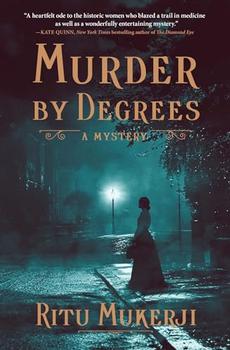
by Ritu Mukerji
Published 2024
For fans of Jacqueline Winspear and Charles Todd, Murder by Degrees is a historical mystery set in 19th century Philadelphia, following a pioneering woman doctor as she investigates the disappearance of a young patient who is presumed dead.

 (1).gif)
Finishing second in the Olympics gets you silver. Finishing second in politics gets you oblivion.
Click Here to find out who said this, as well as discovering other famous literary quotes!

Can you name the title?
Test your book knowledge with our daily trivia challenge!