
-
Your next favorite book
is waiting.
Summary | Excerpt | Reviews | Beyond the book | Read-Alikes | Genres & Themes | Author Bio
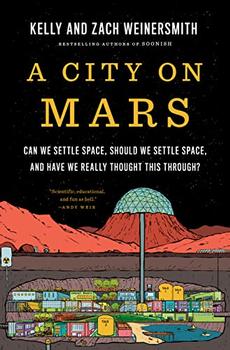
Can We Settle Space, Should We Settle Space, and Have We Really Thought This Through?
by Kelly Weinersmith, Zach Weinersmith Book Reviewed by:
From the bestselling authors of Soonish, a brilliant and hilarious off-world investigation into space settlement
Earth is not well. The promise of starting life anew somewhere far, far away—no climate change, no war, no Twitter—beckons, and settling the stars finally seems within our grasp. Or is it? Critically acclaimed, bestselling authors Kelly and Zach Weinersmith set out to write the essential guide to a glorious future of space settlements, but after years of research, they aren't so sure it's a good idea. Space technologies and space business are progressing fast, but we lack the knowledge needed to have space kids, build space farms, and create space nations in a way that doesn't spark conflict back home. In a world hurtling toward human expansion into space, A City on Mars investigates whether the dream of new worlds won't create nightmares, both for settlers and the people they leave behind. In the process, the Weinersmiths answer every question about space you've ever wondered about, and many you've never considered:
Can you make babies in space? Should corporations govern space settlements? What about space war? Are we headed for a housing crisis on the Moon's Peaks of Eternal Light—and what happens if you're left in the Craters of Eternal Darkness? Why do astronauts love taco sauce? Speaking of meals, what's the legal status of space cannibalism?
With deep expertise, a winning sense of humor, and art from the beloved creator of Saturday Morning Breakfast Cereal, the Weinersmiths investigate perhaps the biggest questions humanity will ever ask itself—whether and how to become multiplanetary.
Get in, we're going to Mars.
1.
A Preamble on Space Myths
Idyllic views of the future always seem to come with the hidden assumption that human nature will change. That somehow, the flaws of mankind will just melt away amongst the awesomeness of living among the stars. People will abandon mundane flaws like booze and drugs, and also everyone will be super-efficient like some kind of environmentalist's dream. But that's never been the case as we march forward, so I don't see why it would happen in the future.
—Andy Weir, world famous sci-fi author who also writes really insightful commentary in books about booze in space.
Outlandish ideas about space settlement often function as a justification for the whole project, typically promising vast wealth, an improved humanity, or an escape from Earth-awfulness. Because much of this book hinges on the idea that there is no urgent need to settle space, here we'll try to convince you that most of the pro-settlement arguments ...
Reading the book is like sitting through your favorite college professor's lecture series. The Weinersmiths approach this immensely complex topic in a clear, organized manner, yet relay it in such a conversational tone that one envisions being in the room with them. Their sense of humor, too, shines through in nearly every paragraph...continued
Full Review
 (611 words)
(Reviewed by Kim Kovacs).
 Andy Weir, New York Times bestselling author of The Martian and Project Hail Mary
Scientific, educational, and fun as hell. Hank Green, New York Times bestselling author of An Absolutely Remarkable Thing and host of CrashCourse and SciShow
There is simply no more engrossing, entertaining, or thorough way to understand the intense challenge of humanity's off-Earth future than A City on Mars. I laughed the whole way through. James S.A. Corey, author of The Expanse series
A City on Mars is deeply researched, hilarious, and sobering. Zach and Kelly Weinersmith have given us a bracing to-do list for the new age of space. Highly, highly recommended. Jonathan McDowell, Center for Astrophysics, via X
A must-read! Jorge Cham, author of Oliver's Great Big Universe and creator of PHD Comics
A fun, and sobering, exploration of what it means to explore beyond our planetary home. Sure, the stars beckon and TV shows and movies make space travel seem like a blast, but before you invest in another billionaire's crypto-powered Mars colonization dream, you might want to pick up this book and learn about the risks, astronomical costs and thorny ethical issues involved. The Weinersmiths take you on a journey to our unlikely future on other planets with impressive detail, eye-opening facts, and extremely funny cartoons. Mary Roach, New York Times bestselling author of Fuzz and Packing for Mars
Listen up, humans. How to poop in space will be the least of our concerns. Herein are challenges most space-heads, including me, never even considered: not just technological, but legal, ethical, geopolitical. Despite the breadth and depth of research and some impressive near-wonk-level detail, this is a clear, lively, and hilarious read. Slam dunk, Weinersmiths! Phil Plait, writer of the "Bad Astronomy Newsletter"
Earth may not be perfect, but we evolved here. Everywhere else in the Universe will try heartily to kill you in nasty ways. The Weinersmiths logically and patiently lay out the case that if we want to live in space, there's a lot of ground work to do first. If you're a gung-ho Moon and Mars enthusiast, this book will show you why it's best to slow down the space race just a bit. Professor Lewis Dartnell, New York Times bestselling author of Being Human
A refreshing, clear-headed breath of life-support oxygen amidst all the tech-bro naivety and hype on space colonisation. Impeccably researched and argued, yet witty and very easy to read. Superb! Scott Aaronson, Schlumberger Chair of Computer Science and Director of Quantum Information Center, University of Texas at Austin
Of the many books and extensive literature on Space mission architectures, technical and otherwise, this is the only one that is a must-read to understand the deep financial, physiological and technical constraints of one of the largest and most ambitious endeavors of our time: enabling humans to become a multi-planetary species.
Andy Weir, New York Times bestselling author of The Martian and Project Hail Mary
Scientific, educational, and fun as hell. Hank Green, New York Times bestselling author of An Absolutely Remarkable Thing and host of CrashCourse and SciShow
There is simply no more engrossing, entertaining, or thorough way to understand the intense challenge of humanity's off-Earth future than A City on Mars. I laughed the whole way through. James S.A. Corey, author of The Expanse series
A City on Mars is deeply researched, hilarious, and sobering. Zach and Kelly Weinersmith have given us a bracing to-do list for the new age of space. Highly, highly recommended. Jonathan McDowell, Center for Astrophysics, via X
A must-read! Jorge Cham, author of Oliver's Great Big Universe and creator of PHD Comics
A fun, and sobering, exploration of what it means to explore beyond our planetary home. Sure, the stars beckon and TV shows and movies make space travel seem like a blast, but before you invest in another billionaire's crypto-powered Mars colonization dream, you might want to pick up this book and learn about the risks, astronomical costs and thorny ethical issues involved. The Weinersmiths take you on a journey to our unlikely future on other planets with impressive detail, eye-opening facts, and extremely funny cartoons. Mary Roach, New York Times bestselling author of Fuzz and Packing for Mars
Listen up, humans. How to poop in space will be the least of our concerns. Herein are challenges most space-heads, including me, never even considered: not just technological, but legal, ethical, geopolitical. Despite the breadth and depth of research and some impressive near-wonk-level detail, this is a clear, lively, and hilarious read. Slam dunk, Weinersmiths! Phil Plait, writer of the "Bad Astronomy Newsletter"
Earth may not be perfect, but we evolved here. Everywhere else in the Universe will try heartily to kill you in nasty ways. The Weinersmiths logically and patiently lay out the case that if we want to live in space, there's a lot of ground work to do first. If you're a gung-ho Moon and Mars enthusiast, this book will show you why it's best to slow down the space race just a bit. Professor Lewis Dartnell, New York Times bestselling author of Being Human
A refreshing, clear-headed breath of life-support oxygen amidst all the tech-bro naivety and hype on space colonisation. Impeccably researched and argued, yet witty and very easy to read. Superb! Scott Aaronson, Schlumberger Chair of Computer Science and Director of Quantum Information Center, University of Texas at Austin
Of the many books and extensive literature on Space mission architectures, technical and otherwise, this is the only one that is a must-read to understand the deep financial, physiological and technical constraints of one of the largest and most ambitious endeavors of our time: enabling humans to become a multi-planetary species.Kelly and Zach Weinersmith's A City on Mars discusses what a space colony on that planet might look like. Science fiction authors, though, have been imagining life on the Red Planet for well over a century (some coming closer to reality than others).
The concept of intelligent life on Mars was likely sparked in the late 19th century. Improved telescopes allowed scientists to notice long, straight lines on its surface (first described by Italian astronomer Giovanni Schiaparelli in 1877). Some speculated that these channels or canals were engineered by some sort of native creature. Although this notion was debunked in the early 20th century, it triggered the idea that there could be intelligent life on Mars, which over the ensuing ...
If you liked A City on Mars, try these:

by Lisa Kaltenegger
Published 2025
Riveting and timely, a look at the research that is transforming our understanding of the cosmos in the quest to discover whether we are alone.
by Samantha Harvey
Published 2024
A slender novel of epic power, Orbital deftly snapshots one day in the lives of six women and men hurtling through space - not towards the moon or the vast unknown, but around our planet.
by Philip Plait
Published 2024
A rip-roaring tour of the cosmos with the Bad Astronomer, bringing you up close and personal with the universe like never before.


 (1).gif)
Choose an author as you would a friend
Click Here to find out who said this, as well as discovering other famous literary quotes!

Can you name the title?
Test your book knowledge with our daily trivia challenge!