
-
Your next favorite book
is waiting.
Summary | Excerpt | Reviews | Beyond the book | Read-Alikes | Genres & Themes | Author Bio
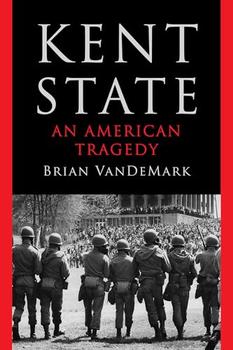
An American Tragedy
by Brian VanDeMark Book Reviewed by:
A definitive history of the fatal clash between Vietnam War protestors and the National Guard, illuminating its causes and lasting consequences.
On May 4, 1970, at Kent State University in Ohio, political fires that had been burning across America during the 1960s exploded. Antiwar protesters wearing bell-bottom jeans and long hair hurled taunts and rocks at another group of young Americans―National Guardsmen sporting gas masks and rifles. At half past noon, violence unfolded with chaotic speed, as guardsmen―many of whom had joined the Guard to escape the draft―opened fire on the students. Two reductive narratives ensued: one, that lethal state violence targeted Americans who spoke their minds; the other, that law enforcement gave troublemakers the comeuppance they deserved. For over fifty years, little middle ground has been found due to incomplete and sometimes contradictory evidence.
Kent State meticulously re-creates the divided cultural landscape of America during the Vietnam War and heightened popular anxieties around the country. On college campuses, teach-ins, sit-down strikes, and demonstrations exposed the growing rift between the left and the right. Many students opposed the war as unnecessary and unjust and were uneasy over poor and working-class kids drafted and sent to Vietnam in their place. Some developed a hatred for the military, the police, and everything associated with authority, while others resolved to uphold law and order at any cost.
Focusing on the thirteen victims of the Kent State shooting and a painstaking reconstruction of the days surrounding it, historian Brian VanDeMark draws on crucial new research and interviews―including, for the first time, the perspective of guardsmen who were there. The result is a complete reckoning with the tragedy that marked the end of the sixties.
Prologue
People don't withhold the whole truth unless the whole truth is too much to bear. For years, he didn't tell people the whole truth—not even his wife. He knew, of course, that he should tell the whole truth, but he always hesitated. His decision initially reflected the danger of legal jeopardy, then the burden of personal responsibility. Telling the whole truth would lead only to harsh criticism and endless speculation about his motives, and he had no desire to deal with either. And he failed to see how it would benefit the victims. Critics couldn't punish him any worse than he had punished himself.
He had spent years in pain, reliving memories of the shooting. Vivid and disturbing, they resurfaced unpredictably, flickering like fish in murky waters. They haunted him, but he could not switch them off. They magnified what he withheld, but it was its very smallness that made it so terrible. Whenever he thought about the victims, it was about what went through their minds in ...
VanDeMark sets out to tell the story of the Kent State shooting from multiple perspectives, "without taking sides," using previously untapped archival documents and interviews with those who were there. The result is a cogent, clear-eyed, and almost minute-to-minute account of the chaos that erupted when young people on both sides of an American cultural divide squared off on the quad of Kent State... May 4th, the "tragic day," is exhaustively covered with nerve-shredding tension as VanDeMark describes the chaos and confusion that swirled around the Guard regiments...continued
Full Review
 (627 words)
(Reviewed by Peggy Kurkowski).
 Julian E. Zelizer, Princeton University
Brian VanDeMark provides an insightful look back at one of the most tragic moments of the 1970s when four students at Kent State University were killed by the Ohio National Guard. VanDeMark unpacks how the story unfolded, shattering some conventional narratives that we have about what took place in this shocking moment in American history. Kai Bird, Pulitzer Prize–winning biographer and executive director of the Leon Levy Center for Biography
Kent State is a brilliant book, a riveting and emotionally wrenching story about the day the Sixties died. Brian VanDeMark has achieved something rare, a narrative that honors both those who died and those who killed on May 4, 1970. When I was an 'angry young man' at the time, I could not understand it, but VanDeMark has revealed the facts behind the tragedy. It is a remarkable scholarly achievement about a tipping point in America's divisive political landscape. Robert Dallek, presidential historian
Brian VanDeMark's beautifully written book forcefully reminds us of the Vietnam War's impact on American domestic life, and the strife that tore us apart and destroyed innocent lives―as at Kent State.
Julian E. Zelizer, Princeton University
Brian VanDeMark provides an insightful look back at one of the most tragic moments of the 1970s when four students at Kent State University were killed by the Ohio National Guard. VanDeMark unpacks how the story unfolded, shattering some conventional narratives that we have about what took place in this shocking moment in American history. Kai Bird, Pulitzer Prize–winning biographer and executive director of the Leon Levy Center for Biography
Kent State is a brilliant book, a riveting and emotionally wrenching story about the day the Sixties died. Brian VanDeMark has achieved something rare, a narrative that honors both those who died and those who killed on May 4, 1970. When I was an 'angry young man' at the time, I could not understand it, but VanDeMark has revealed the facts behind the tragedy. It is a remarkable scholarly achievement about a tipping point in America's divisive political landscape. Robert Dallek, presidential historian
Brian VanDeMark's beautifully written book forcefully reminds us of the Vietnam War's impact on American domestic life, and the strife that tore us apart and destroyed innocent lives―as at Kent State.Of all the unsettling photos taken at Kent State University on May 4th, 1970, one of them became the iconic image of unthinkable tragedy. In this photo, twenty-year-old student Jeff Miller lies face down bleeding as fourteen-year-old Mary Ann Vecchio screams in horror over his body. The photographer was KSU student John Filo, and the future Pulitzer Prize-winning photo ran three columns wide on the next morning's New York Times, according to historian Brian VanDeMark in Kent State: An American Tragedy. With its dramatic content, composition, and Vecchio's wailing pose, the photograph has been called the "Kent State Pietà."
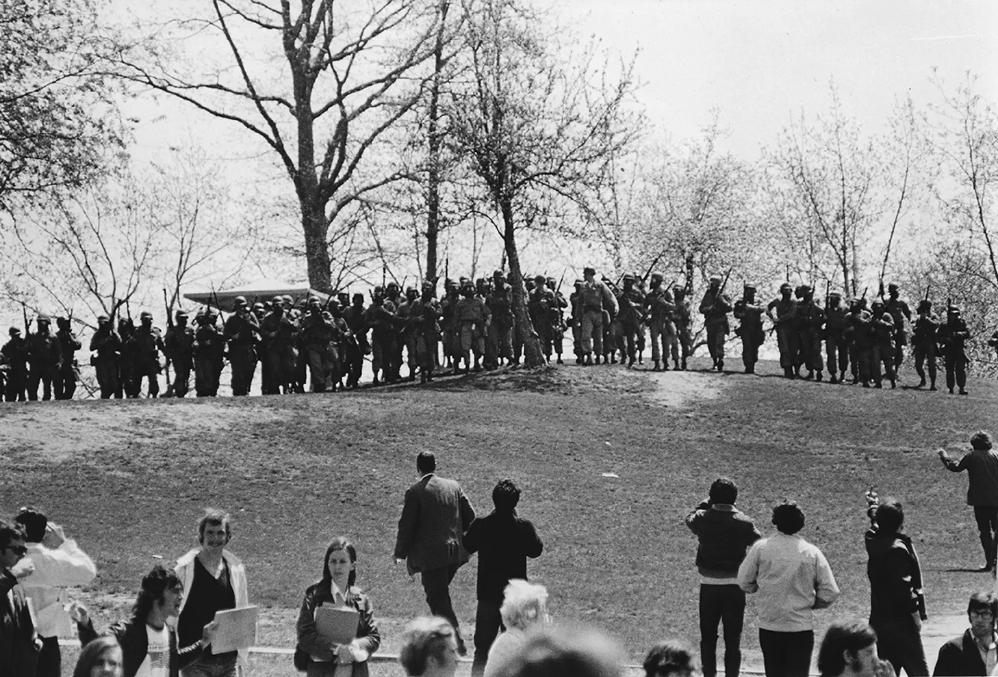
While Filo garnered prestige for his photo, Vecchio had a vastly dissimilar experience that has haunted her...
If you liked Kent State, try these:

by Candace Fleming
Published 2025
How did Jim Jones, the leader of Peoples Temple, convince more than 900 of his followers to commit "revolutionary suicide" by drinking cyanide-laced punch? From a master of narrative nonfiction comes a chilling chronicle of one of the most notorious cults in American history.
by Paul Auster
Published 2025
An intimate and powerful rumination on American gun violence by Paul Auster, one of our greatest living writers and "genuine American original" (The Boston Globe), in an unforgettable collaboration with photographer Spencer Ostrander
by Julian Rubinstein
Published 2022
An award-winning journalist's dramatic account of a shooting that shook a community to its core, with important implications for the future


 (1).gif)
Idealism increases in direct proportion to one's distance from the problem.
Click Here to find out who said this, as well as discovering other famous literary quotes!

Can you name the title?
Test your book knowledge with our daily trivia challenge!