
-
Your next favorite book
is waiting.
Summary | Excerpt | Reviews | Read-Alikes | Genres & Themes | Author Bio

Brain Science and the Biology of Belief
by Andrew Newberg, M.D., Eugene d'AquiliNewberg and D'Aquili show that the religious impulse is rooted in the biology of the brain--but is religion merely a product of biology or has the human brain been mysteriously endowed with the unique capacity to reach and know God?
Why have we humans always longed to connect with something larger than ourselves? Why does consciousness inevitably involve us in a spiritual quest? Why, in short, won't God go away? Theologians, philosophers, and psychologists have debated this question through the ages, arriving at a range of contradictory and ultimately unprovable answers. But in this brilliant, groundbreaking new book, researchers Andrew Newberg and Eugene d'Aquili offer an explanation that is at once profoundly simple and scientifically precise: the religious impulse is rooted in the biology of the brain.
Newberg and d'Aquili base this revolutionary conclusion on a long-term investigation of brain function and behavior as well as studies they conducted using high-tech imaging techniques to examine the brains of meditating Buddhists and Franciscan nuns at prayer. What they discovered was that intensely focused spiritual contemplation triggers an alteration in the activity of the brain that leads us to perceive transcendent religious experiences as solid and tangibly real. In other words, the sensation that Buddhists call "oneness with the universe" and the Franciscans attribute to the palpable presence of God is not a delusion or a manifestation of wishful thinking but rather a chain of neurological events that can be objectively observed, recorded, and actually photographed.
The inescapable conclusion is that God is hard-wired into the human brain.
In Why God Won't Go Away, Newberg and d'Aquili document their pioneering explorations in the field of neurotheology, an emerging discipline dedicated to understanding the complex relationship between spirituality and the brain. Along the way, they delve into such essential questions as whether humans are biologically compelled to make myths; what is the evolutionary connection between religious ecstasy and sexual orgasm; what do Near Death Experiences reveal about the nature of spiritual phenomena; and how does ritual create its own neurological environment. As their journey unfolds, Newberg and d'Aquili realize that a single, overarching question lies at the heart of their pursuit: Is religion merely a product of biology or has the human brain been mysteriously endowed with the unique capacity to reach and know God?
Blending cutting-edge science with illuminating insights into the nature of consciousness and spirituality, Why God Won't Go Away bridges faith and reason, mysticism and empirical data. The neurological basis of how the brain identifies the "real" is nothing short of miraculous. This fascinating, eye-opening book dares to explore both the miracle and the biology of our enduring relationship with God.
Contents
Notes
Reference
Index
Chapter One
A Photograph of God? An introduction to the Biology of Belief
In a small, dark room at the lab of a large university hospital, a young man named Robert lights candles and a stick of jasmine incense; he then settles to the floor and folds his legs easily into the lotus position. A devout Buddhist and accomplished practitioner of Tibetan meditation, Robert is about to begin another meditative voyage inward. As always, his goal is to quiet the constant chatter of ...
 Father G. Ronald Murphy, SJ, Professor, Georgetown University
This work is of tremendous importance in advancing the relationship of science and religion. Few investigators have been able to match the authors' research on the neurological basis of religious experience or their theological analysis and evaluation of this experience. Why God Won't Go Away shows that the mind necessarily includes spiritual and religious experiences. Herbert Benson, M.D., President, Mind/Body Medical Institute and Author of The Relaxation Response and Timeless Healing
A wonderful assessment of the brain and its activity when God is experienced. This should be fascinating to all who are interested in the relationship between humans and God. Larry Dossey, M.D., Author of Reinventing Medicine and Healing Word
A thrilling exploration of the intersection of modern brain science and religious experience by one of the leading researchers in the field….Newberg's reverential attitude toward the great unknowns is reminiscent of Einstein. Mona Lisa Schulz, M.D., Ph.D., Author of Awakening Intuition
This is one of the most exciting books I have read in my entire career in neuropsychiatry and intution! Why God Won't Go Away shows how one key area in our brain biologically wires us to be connected to each other, the universe, and God. Truly brilliant.
Father G. Ronald Murphy, SJ, Professor, Georgetown University
This work is of tremendous importance in advancing the relationship of science and religion. Few investigators have been able to match the authors' research on the neurological basis of religious experience or their theological analysis and evaluation of this experience. Why God Won't Go Away shows that the mind necessarily includes spiritual and religious experiences. Herbert Benson, M.D., President, Mind/Body Medical Institute and Author of The Relaxation Response and Timeless Healing
A wonderful assessment of the brain and its activity when God is experienced. This should be fascinating to all who are interested in the relationship between humans and God. Larry Dossey, M.D., Author of Reinventing Medicine and Healing Word
A thrilling exploration of the intersection of modern brain science and religious experience by one of the leading researchers in the field….Newberg's reverential attitude toward the great unknowns is reminiscent of Einstein. Mona Lisa Schulz, M.D., Ph.D., Author of Awakening Intuition
This is one of the most exciting books I have read in my entire career in neuropsychiatry and intution! Why God Won't Go Away shows how one key area in our brain biologically wires us to be connected to each other, the universe, and God. Truly brilliant.
If you liked Why God Won't Go Away, try these:
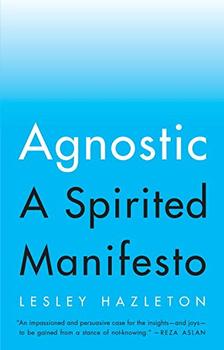
by Lesley Hazleton
Published 2017
A widely admired writer on religion celebrates agnosticism as the most vibrant, engaging - and ultimately the most honest - stance toward the mysteries of existence.

by Christopher Hitchens
Published 2009
Hitchens frames the argument for a more secular life based on science and reason, in which hell is replaced by the Hubble Telescope's awesome view of the universe, and Moses and the burning bush give way to the beauty and symmetry of the double helix.

by William Lobdell
Published 2009
William Lobdell's journey of faith—and doubt—may be the most compelling spiritual memoir of our time. It is a book about life's deepest questions that speaks to everyone: Lobdell understands the longings and satisfactions of the faithful, as well as the unrelenting power of doubt.



 (1).gif)
Beware the man of one book
Click Here to find out who said this, as well as discovering other famous literary quotes!

Can you name the title?
Test your book knowledge with our daily trivia challenge!