
-
Your next favorite book
is waiting.
Summary | Excerpt | Reviews | Beyond the Book | Readalikes | Genres & Themes | Author Bio
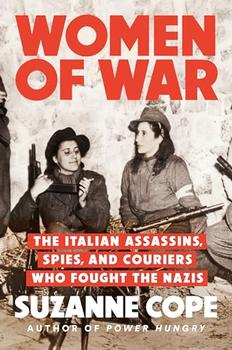
The Italian Assassins, Spies, and Couriers Who Fought the Nazis
by Suzanne Cope Book Reviewed by:
While Ugo was having his revelation on the battlefield, Benito gradually came to support the war from behind a desk. Soon, he began writing articles and giving speeches supporting Italy's involvement. Making a name for himself within conservative politics, he was eventually ousted from his role at Avanti! and from the Socialist Party. Undaunted, Benito Mussolini founded his own newspaper, Il Popolo d'Italia, in Milan in 1914, and then began gathering veterans and like-minded politicians to form the Fascist Party in 1919, the year after the end of the Great War.
Over the next few years he would bring together conservative Italians who were upset at the liberal direction their country was taking. They wanted to elevate Italy's current standing in the world-hence the rallying cry "Bring back the Roman Empire!"-while also keeping wealth and power concentrated among the land and business owners by fearmongering about the ills of Communism and Socialism.
On October 28, 1922, Mussolini's small band of loyalists marched on Rome, demanding that the king hand over control of the government, or they would "take it by force." Within days King Vittorio Emanuele III acquiesced and handed Mussolini the positions of both prime minister and interior minister without a fight.
In 1933 the Mattei family moved to the countryside, to a large house in a small town overlooking the city of Florence, after Ugo's partner had squandered the telephone company's profits and run off with a dancer. In Tuscany the family became enmeshed with the local anti-Fascist community, including known writers and intellectuals like Natalia Ginzburg and Carlo Levi, political thinkers like Piero Calamandrei, and left-leaning entrepreneurs such as Adriano Olivetti, whose family made typewriters. The Mattei family often received guests, sometimes quietly arriving in the dark of night to evade the surveillance of Mussolini's black-shirted squadristi, his loyalist police force. Teresa came of age hearing political debate and conversation around the dinner table.
As a young teen Teresa helped her family print clandestine newspapers signed by "The Anti-Fascist Front for Peace." They printed them on paper the size of a Florentine bread pan, and Teresa would stack copies in a pan, wrapping it with a towel. And then she set off; few noticed the girl with a basket of bread, delivering her goods to the mailboxes around Florence.
By then Mussolini had been in power for more than a decade and had, in effect, invented the concept of "Fascism" to serve his own authoritarian desires. Teresa was brought up to resist this doctrine that states, in Mussolini's own words-but widely considered ghostwritten by Fascist ideologist and philosopher Giovanni Gentile-"Fascism ... believes neither in the possibility nor the utility of perpetual peace... . War alone brings up to its highest tension all human energy and puts the stamp of nobility upon the peoples who have courage to meet it... . Fascism conceives of the State as an absolute, in comparison with which all individuals or groups are relative, only to be conceived of in their relation to the State." A core tenet of the philosophy of Fascism was abject nationalism, with complete trust and loyalty given to Mussolini, the country's ultimate leader. It was a government in charge of all facets of life, shaping the way that citizens lived in and understood the world around them.
Although Mussolini was certainly convinced wealthy land and business owners should be left to their own devices, particularly under the Fascist belief in the "immutable, beneficial, and fruitful inequality of mankind." Fruitful indeed, but only for a select few. Unlike the ideals of Communists, who believed in equal access to commodities, or Socialists, who argued that workers should be compensated according to their effort, labor, and productivity, Mussolini and his totalitarian government-the term was first used to describe his leadership-would decide who were the haves and who were the have-nots. And he worked to build his (relative) popularity with vast public projects-pouring money into buildings, transportation, and other infrastructure, making some people quite rich and impressing many others. These were often designed in the telltale rationalist style-minimalist and chunky design, adorned with Fascist symbolism like the laurel wreath of victory, taken from ancient Roman empire iconography, or the fasces from which the party derived its name-which referred to a bundle of sticks tied together with an axe, an ancient symbol of power and authority.
Excerpted from Women of War by Suzanne Cope. Copyright © 2025 by Suzanne Cope. Excerpted by permission of Dutton. All rights reserved. No part of this excerpt may be reproduced or reprinted without permission in writing from the publisher.


 (1).gif)
We've heard that a million monkeys at a million keyboards could produce the complete works of Shakespeare...
Click Here to find out who said this, as well as discovering other famous literary quotes!

Can you name the title?
Test your book knowledge with our daily trivia challenge!
Your guide toexceptional books
BookBrowse seeks out and recommends the best in contemporary fiction and nonfiction—books that not only engage and entertain but also deepen our understanding of ourselves and the world around us.