
-
Your next favorite book
is waiting.
Summary | Excerpt | Reviews | Beyond the Book | Readalikes | Genres & Themes | Author Bio
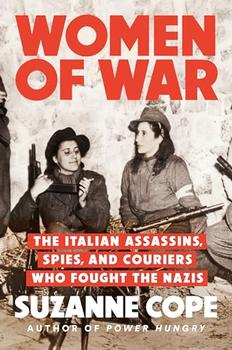
The Italian Assassins, Spies, and Couriers Who Fought the Nazis
by Suzanne Cope Book Reviewed by:
Mussolini loved giving bombastic speeches to large crowds-his favorite stage was a window overlooking the Piazza Venezia in Rome. They were broadcast across the country via radio, his followers dutifully cheering and chanting, Credere, Obbedire, Combattere-"Believe, Obey, Fight." And Mussolini was among the first leaders to take advantage of the new media of film, popularized during the 1920s and '30s. He ordered hundreds of hours of propaganda movies that, to this day, are sometimes referenced uncritically as the only representations of life during this time, though they blurred fact with the fictional Italy that Mussolini attempted to portray.
Italians seemed to love Il Duce-"the leader"-or at least this was the expected public response at the many nationalistic events held around the country. Attendance was, if not absolutely required, certainly strongly suggested. Absences were noticed. There was an expectation of complete fidelity to the homeland of Italy. That expectation was reinforced by laws passed with little fanfare or debate, which were upheld by Il Duce's squadristi, who were known to use violence and intimidation to keep detractors in line.
Within a decade, Mussolini had squelched all but the most covert anti-Fascist movements. And he began indoctrinating the youth with his Fascist ideology while ignoring history that illustrated other forms of governing or resistance. Many books that were written by foreigners or offered a different worldview were banned or restricted. Teresa's generation was brought up learning only propaganda-laden curricula at state-run schools and in ubiquitous Fascist social groups. Government criticism, for the most part, was only whispered to the most trusted friends and family members, long after the children had gone to bed. Some anti-Fascist sentiment was still tolerated among those with money and social influence-as long as these detractors didn't seem to be getting out of hand.
The Matteis were among those who were known anti-Fascists, and thus were generally kept under close surveillance. Ugo was a member of the Justice and Liberty movement, founded in 1929 with the likes of Carlo Rosselli, who was much more outspoken and had ended up arrested, sent to confinement-where mostly political prisoners were exiled on distant islands for years at a time as punishment-and, eventually, killed for his opposition to Mussolini in the late 1930s. Decades later a defense of Il Duce would be "At least Mussolini never had anyone killed!"-which was certainly not true. But he did prefer aggression, intimidation, and confinement of detractors and, later, Jewish people-to outright murder.
Ugo felt no need to feign acceptance of the Fascist Party, rather bringing up Teresa and her siblings to question authority, critique the church, and think for themselves. When Mussolini had public events nearby, Ugo was often preemptively arrested and then released a few days later, and he was required to periodically check in with the local carabinieri office so they could keep tabs on him. Local Blackshirts, as the squadristi were also known, understood the nuanced dance of keeping someone like Ugo in line. He could speak his mind-to a point-as long as he was not seen as calling people to action.
On October 3, 1935, Italy invaded Ethiopia, known then as Abyssinia, without provocation, in a show of power and a bid for land expansion. This act of aggression came just months after Hitler began bolstering Germany's armed forces, in defiance of World War I treaties, and just weeks after the Third Reich passed the Nuremberg Laws, greatly limiting Jewish people's liberties.
Italy quickly faced economic sanctions from the League of Nations and government leaders began their own propaganda campaign against what they considered an unfair rebuke. Later that autumn in Florence a plaque was installed calling for youths to seek revenge against the United Nations. Across the city it was widely announced that there was to be a parade of students the next day; instead of regular lessons, they would march by the plaque and consider its message.
Excerpted from Women of War by Suzanne Cope. Copyright © 2025 by Suzanne Cope. Excerpted by permission of Dutton. All rights reserved. No part of this excerpt may be reproduced or reprinted without permission in writing from the publisher.



 (1).gif)
We have to abandon the idea that schooling is something restricted to youth...
Click Here to find out who said this, as well as discovering other famous literary quotes!

Can you name the title?
Test your book knowledge with our daily trivia challenge!
Your guide toexceptional books
BookBrowse seeks out and recommends the best in contemporary fiction and nonfiction—books that not only engage and entertain but also deepen our understanding of ourselves and the world around us.